

You lit your joint, took a few hits, and now one side is racing ahead while the other just sits there like a dead ember. That uneven burn is called canoeing, and if you've ever watched a perfectly good joint turn into a lopsided mess, you know how fast it ruins the whole session. Learning how to stop a joint from canoeing starts with understanding why it happens in the first place, and most of the time it comes down to packing density and paper quality.
The fix isn't complicated once you know what's causing the problem. Uneven grinding, damp or uneven herb distribution, and low-quality rolling papers are the usual culprits, and each one has a specific, practical solution you can apply the next time you roll. Rotating your joint as you smoke and fixing a canoe mid-session with a lighter or wet fingertip also buys you time when things start going sideways.
In this guide, we'll walk through the exact techniques to prevent canoeing before it starts, plus quick fixes for when it happens anyway. We'll also cover why switching to RAW pre-rolled cones eliminates most of this hassle entirely, since a proper slow-burn design solves the problem at the source.
What causes a joint to canoe
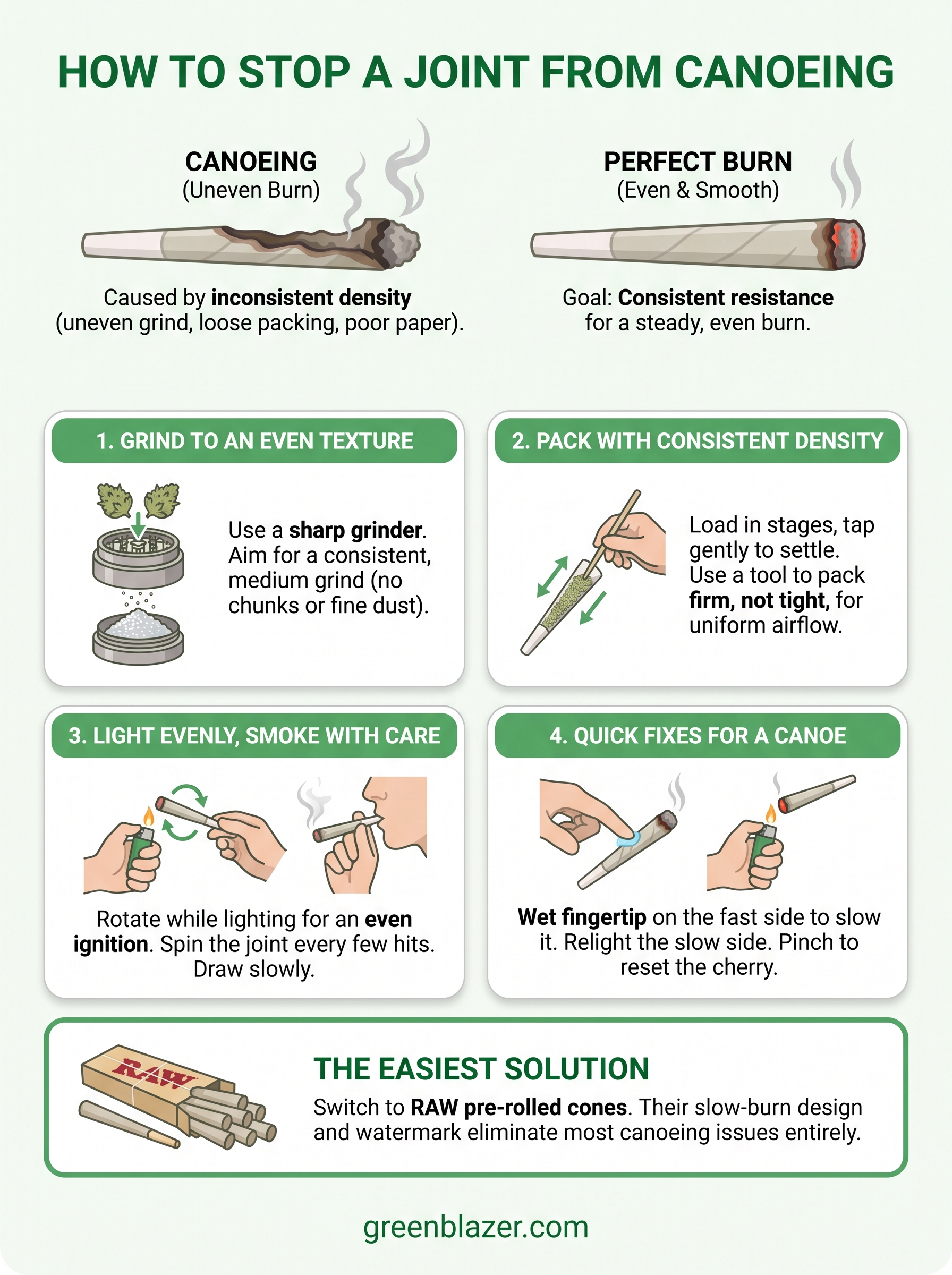
Canoeing happens when one section of your joint burns faster than the rest, leaving a hollowed-out trench on one side while the other side goes dark and unlit. The root cause is almost always inconsistent density somewhere along the roll. Flower packed loosely in one spot burns like kindling, while a denser pocket next to it acts like a dam and stops that side of the cherry from moving forward. Add in cheap paper, a stray draft, or a damp patch of bud, and you've got the perfect setup for a canoe.
Inconsistent packing density
Most canoeing starts here. If you grind unevenly, you end up with big chunks and fine dust sitting side by side inside the paper. The dust ignites almost instantly, and the chunks resist the flame, so the burn line tilts toward whichever side has less resistance.
A joint canoes because one side of the roll has less resistance to fire than the other.
Low-quality or uneven papers
Many drugstore papers use chemical sizing to help them hold together, and that sizing doesn't burn at a consistent rate across the sheet. Thin spots burn fast, thick spots burn slow, and the paper itself becomes part of the problem before you even factor in the flower, which is why paper thickness and heat resistance matter so much.
Moisture and airflow issues
Never ignore humidity. Flower that's slightly damp on one side, maybe from sitting near a lid seal or an unevenly cured batch, will smolder instead of burning clean, so dialing in the right moisture level for your flower is worth the effort. Outdoor wind or even a ceiling fan blowing across your hand while you smoke pushes more oxygen to one side, speeding that side up while the other lags behind, which is exactly what makes smoking in windy conditions such a challenge.
Step 1. Grind your flower to an even texture
Grinding sets the foundation for the whole joint, so don't rush it. A consistent grind size means every part of your joint has the same resistance to fire, which is the single biggest factor in preventing canoeing. Skip the scissors and skip breaking buds apart by hand, since both methods leave you with a mix of large chunks and fine powder that burns at wildly different speeds.
Choose the right grinder
Grab a sharp, multi-chamber grinder with medium-sized teeth, not the cheap plastic kind with dull blades that shred unevenly, and dial in the grinder settings that avoid overpacking. A four-piece grinder with a kief catcher works well because the screen filters out excess dust before it ever reaches your rolling paper.
Check your texture before rolling
Run your fingers through the ground flower and look for uniformity.
- No stems or seeds left in the mix
- No large, unbroken chunks
- No fine dust clumping at the bottom
- Texture similar to coarse sea salt
If your grind isn't consistent, nothing you do afterward will stop the canoe.
Spend the extra thirty seconds here. It saves you a ruined joint later.
Step 2. Roll and pack with consistent density
Once your grind is even, the next job is distributing it so every inch of the joint has the same amount of flower pressing against the paper. Even distribution matters more than how tight you pack, so resist the urge to cram one end full and leave the other thin, and it helps to understand how packing density impacts burn quality.
Load in stages, not all at once
Don't dump your whole grind in at the start, whether you're rolling from scratch or packing a cone instead of rolling one. Add flower in small pinches, working from the tip toward the mouthpiece, and tap the joint gently after each addition so it settles without creating air pockets.
- Fill a third of the paper, tap, check for gaps
- Add another third, tap again
- Finish the last section and pack the end with a rolling stick or pen cap
A joint packed unevenly will canoe no matter how good your grind is.
Pack firm, not tight
Use a rolling stick or the blunt end of a pen to firm up the packing after you've rolled the paper closed. You want gentle, consistent resistance when you press against the joint, not a rock-hard tube that won't draw air, and not a floppy one that collapses at the first hit.
Step 3. Light it evenly and smoke with care
How you light your joint matters just as much as how you rolled it. Rotate the joint slowly while holding the flame underneath, turning it like a rotisserie so the fire catches the entire circumference at once instead of just one edge. Even ignition sets the burn line straight from the first hit, and skipping this step is one of the fastest ways to start a canoe before you've even taken a puff.
Use a lighter, not matches
Matches burn hot and fast in one direction, which pushes flame unevenly across the tip. A standard lighter, held at a slight angle and moved in a slow circle, gives you far more control over how the cherry forms.
Rotate as you smoke
Every few hits, spin the joint a quarter turn between your fingers. This keeps the cherry burning evenly across the whole face instead of favoring whichever side happens to face up or catch a draft.
Rotating your joint every few hits is the cheapest insurance you have against canoeing mid-session.
Draw slowly and steadily too. Sharp, aggressive pulls overheat one side and invite the exact problem you're trying to avoid.
Step 4. Fix a joint that's already canoeing
Sometimes you catch the trench too late to prevent it, but you can still save the joint. Wet fingertip technique works best here: lick your finger and press it lightly against the unlit side of the canoe, right where the burn is racing ahead. The moisture slows that section down and gives the lagging side a chance to catch up.
Apply a flame to the slow side
Instead of relighting the whole tip, aim your lighter directly at the unlit trench for two or three seconds. This nudges that side forward without dumping more heat into the side that's already burning fine.
Rotate and pinch as needed
- Spin the joint so the canoe faces up
- Pinch out any runaway cherry with damp fingers
- Relight gently from the slower side only
A canoe caught early is a quick fix; a canoe ignored becomes a wasted joint.
Timing matters more than technique once canoeing starts. Catching it within the first few hits saves the joint. Waiting until half the paper has burned unevenly usually means you're smoking ash and paper instead of flower, and sticky, resinous strains make it worse, so it pays to know the tricks for preventing canoeing with sticky weed.
Rolling toward a smoother session
Canoeing isn't bad luck. It's a mechanical problem with a mechanical fix: grind evenly, pack evenly, light evenly, and rotate as you smoke. Master those four steps and you'll rarely see a trench form in the first place, and when one does sneak up on you, a wet fingertip and a quick pinch will bail you out before the joint's ruined.
Still, hand-rolling always leaves room for human error. Grinders miss spots, hands shake, papers vary batch to batch. If you'd rather skip the guesswork entirely, RAW pre-rolled cones solve the problem at the source with their slow-burn design and acacia gum line, so every hit burns clean without babysitting the cherry. Load one, light it, and enjoy the session instead of managing a canoe.
Ready to stop fighting your papers? Grab a pack of RAW pre-rolled cones in the 1 1/4 size at Green Blazer and enjoy your next joint the easy way.
