

The fastest way to learn how to fix a canoeing joint is to stop pulling, hold it upright, dab a little water on the side that is burning too fast, and rotate the joint so the slow side catches up. If the burn has already tunneled, stub it out, even off the tip, and relight the whole edge. Then fix the cause, which is nearly always the grind, the moisture, the pack, or the light.
Canoeing, also called running or tunneling, happens when the cherry races down one side of the paper and leaves a strip of unburned flower on the other. You waste flower, the smoke turns harsh, and you spend the session relighting. It feels random, but it is not. Every canoe traces back to something you can see and change.
This guide walks through four steps in the order you will need them: rescue the joint in your hand, reset it if the damage is deep, light and smoke it properly, and fix the cause before you roll again. Green Blazer is a Las Vegas distributor of RAW cones, and uneven burns are a common frustration for the smokers we serve. So the advice here focuses on what actually works at home.
Why a joint canoes in the first place
A joint canoes when heat and airflow reach one side of the cherry more than the other. The faster side burns down, the slower side gets left behind, and the gap grows with every draw. Knowing which cause you are dealing with tells you which fix to use.
The five usual causes
Most canoes come from one of five things. Light and grind problems show up early, while moisture and packing problems show up later in the burn. Here is how to match what you see to what you do.
| Cause | What it looks like | Fix |
|---|---|---|
| Uneven light | Canoe starts on the first puff | Light the whole edge before drawing |
| Coarse or mixed grind | Random fast and slow patches | Grind fine and even |
| Wet or mixed moisture | Burns dark, goes out, or runs in pockets | Equalize the flower before rolling |
| Uneven pack | Canoe at a loose or dense spot | Pack evenly along the length |
| Hard pulls or wind | Ash runs down one side | Draw gently, shield the cherry |
How to read your own canoe
Look at where the canoe begins. If it starts right at the tip, you lit one side more than the other. If the burn is straight at first and then veers off midway, you probably hit a dense spot or a damp pocket. If one side runs fast the whole way, check the grind and the pack.
Outdoor smoking adds wind to the list. A breeze pushes heat to one side of the cherry, and no technique fully cancels it, so cup your hand around the tip.
Where the canoe starts tells you what caused it, so read the burn before you fix it.
Step 1. Stop pulling and slow the fast side
To fix a canoeing joint mid-session, stop drawing, slow the fast-burning side, and let the slow side catch up. You do not need to relight or start over yet. Most light canoes correct within a minute.
Pause and hold the joint upright
Put the joint down or hold it vertically with the cherry on top. Hard pulls drag airflow down one side and feed a canoe, so every extra draw makes it worse. Wait 10 to 15 seconds, which also lets the cherry cool.
Leave the ash on the tip for now. Ash acts as a thin shield against wind and keeps the cherry from running hot.
Slow the fast side
The wet method is the most reliable fix, and it takes about twenty seconds. Follow these steps:
- Find the side with the burn line running ahead.
- Dampen your fingertip with water or saliva.
- Press it lightly along the paper on that side, just below the burn line. Do not soak the paper.
- Hold the lighter flame near the slow side only, rotating the joint until that edge glows.
- Take two gentle draws and check the burn line.
If the ember still runs unevenly, blow across it softly once or twice. The airflow redistributes the glow. Rotate the joint a quarter turn between draws so no single side stays closest to the heat.
Slow the fast side with a damp fingertip, then light only the slow side.
Step 2. Reset a joint that has tunneled
If the unburned strip is longer than about half an inch and the wet method has not closed the gap after a few draws, reset the joint. This is a rule of thumb, not a hard line. A deep canoe rarely corrects itself, and forcing it wastes more flower than a clean relight.
Stub out and even off the tip
Snuff the ember in a tray and tap off the loose ash. Then pinch or trim the ragged end so the tip is flat and the flower sits level across the paper. A flat tip gives you a fresh, even surface to light.
Do not press hard while you shape it. You want the flower in the paper to stay in place, not compact further.
Loosen dense spots and relight
Roll the joint gently between your fingers, working along the length. This loosens over-packed sections that restrict airflow. Go lightly, because heavy pressure creates new dense spots somewhere else.
Relight with the lighter held just off the paper, moving the flame around the whole circumference. Rotate the joint slowly. Wait until a full ring of ember glows before your first draw.
A flat tip and a full ring of ember turn a ruined joint back into a good one.
Step 3. Light and smoke it for an even burn
Most canoes are decided in the first ten seconds, so light the entire crown before you draw. After that, steady, gentle pulling keeps the burn straight. These two habits prevent more canoes than any gadget.
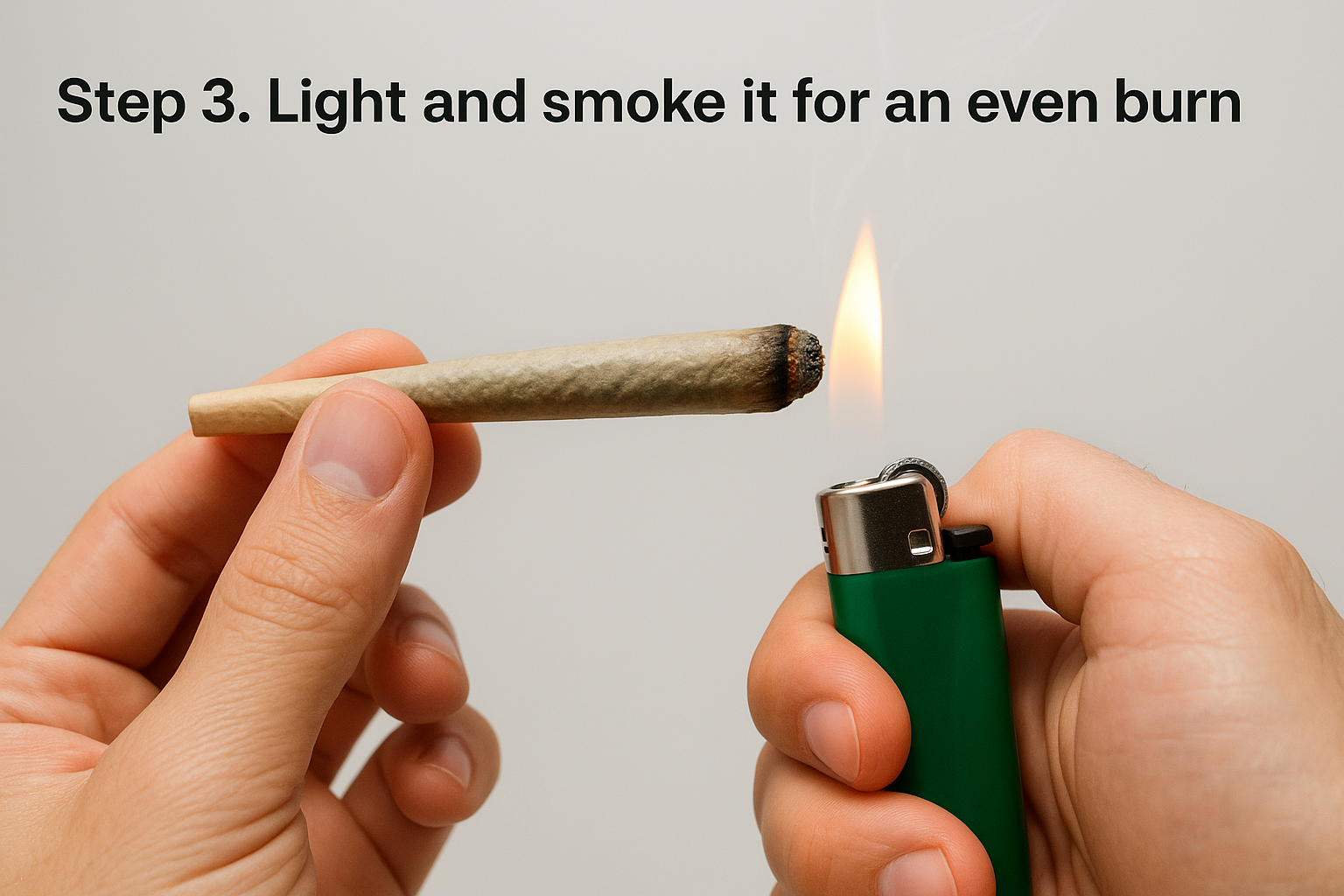
Light the whole crown first
Hold the flame just off the tip and rotate the joint slowly, as you would with a cigar. Keep going until the ember forms a complete ring around the edge. If you pull while one side is still unlit, the airflow follows the lit side and the canoe starts immediately.
Folded tips tend to light more evenly than twisted ones, but either works if you take your time. A standard butane lighter is fine. If you use matches, choose sulfur-free ones so the smoke does not pick up an off taste.
Pull gently and rotate
Draw slowly and wait 10 to 15 seconds between hits. A long, hard pull runs the cherry hot and pulls the burn to one side. A steady draw keeps the burn temperature and the airflow balanced.
Between pulls, hold the joint vertically and roll it slightly in your fingers. Resist knocking off the ash after every hit. It insulates the cherry and keeps heat even. In wind, cup your free hand around the tip.
Light the full ring first, then pull slowly and rotate between hits.
Step 4. Fix the cause before you roll again
Preventing the next canoe means fixing the grind, the moisture, and the pack. Fixing a canoe mid-session is a patch, while these three habits stop it from forming. This is also where your tools matter most.
Grind fine and balance the moisture
Use a grinder rather than tearing the flower by hand. Uneven particle sizes burn at different rates, so check the grind and run it again if you see large chunks. A fine, even grind is the easiest single fix.
Moisture matters just as much. Flower that is too wet burns dark and unevenly, while flower that is too dry burns fast and harsh. If your flower feels sticky, leave it in a jar with the lid off for a day or two and check it often. A two-way humidity pack, commonly sold in the 58 to 62 percent range, holds it steady afterward. Do not mix strains with very different dryness in the same joint.
Pack evenly, by hand or with a loader
Uneven packing is the cause people overlook. Tight spots restrict airflow, and loose spots burn too fast. Add flower in small amounts and tamp lightly with a packer tool or a pencil, working the full length of the cone or paper.
A loader takes most of the guesswork out. The RAW Cone Loader for 1-1/4, King and 98 Special ($9.99) includes a funnel, a packer tool, and a scoop card, and its slotted guard ring controls how much material goes in. The RAW Six Shooter for King Size ($19.99) fills up to six cones at once. It is built for 109mm King Size cones, and 1 1/4 cones sit too low in it to fill properly.
Even then, a good cone does not remove the need for a good pack. RAW Classic cones use natural, unbleached paper meant for a slow, even burn, but an unevenly filled cone can still canoe.
Fix the grind, the moisture, and the pack, and most canoes never start.
Keep your next joint burning straight
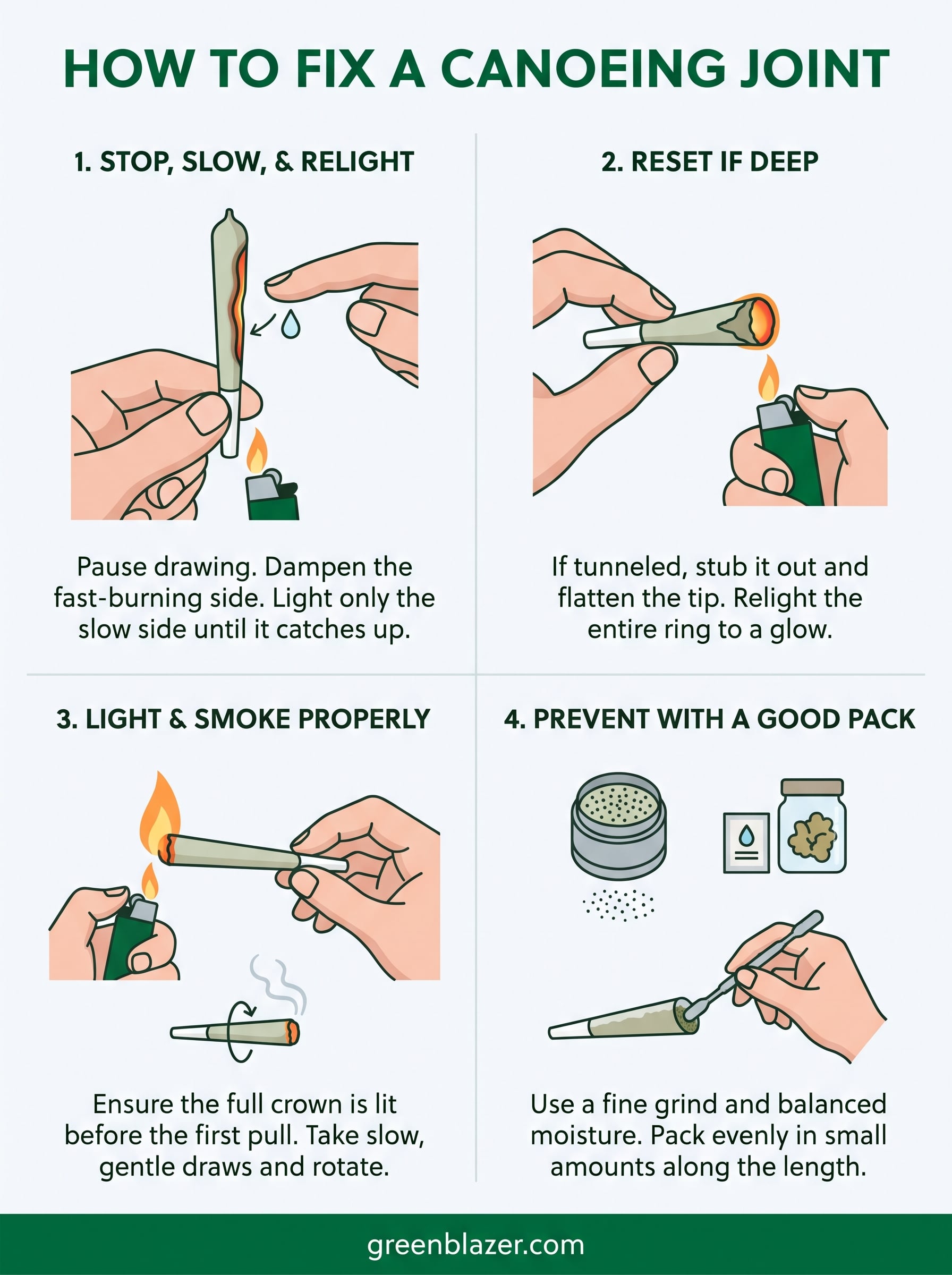
To fix a canoeing joint, stop pulling, slow the fast side with a damp fingertip, and light the slow side. If the burn has tunneled, stub it out, flatten the tip, and relight the full ring. Then prevent the next one with a fine grind, balanced moisture, an even pack, and a patient first light.
Run through those four steps and you will rarely see a canoe again. If you want to start from an evenly filled cone, you can shop RAW Classic cones and loaders at Green Blazer.
