

Grind your weed too fine and it turns to dust, clogging your grinder screen and choking airflow in a joint or bowl. Grind it too coarse and you get uneven burns, harsh hits, and wasted flower sitting unlit at the edges. How fine should you grind weed depends entirely on what you're smoking it in, and getting that texture wrong is one of the most common reasons sessions taste bad or burn poorly.
The short answer: joints and pre-rolled cones want a medium-fine, fluffy consistency that packs evenly without choking airflow, while bowls and bongs can handle a slightly coarser grind since gravity and water do some of the work for you. Vaporizers sit somewhere in between, needing a grind fine enough for even heat distribution but not so fine it slips through the screen.
In this guide, you'll get the exact texture to aim for with each method, what happens when you grind too fine or too coarse, and simple tricks for hitting the right consistency every time, whether you're using a grinder, scissors, or your fingers. If you're rolling your own cones, dialing in the grind is the difference between a smooth, slow burn and a canoeing mess.
Why grind size matters for your smoking experience
Grind size controls three things every time you light up: how air moves through your flower, how evenly it combusts, and how much flavor and potency actually reach your lungs instead of going up in smoke unused. Particle size determines the surface area exposed to flame or heat, and surface area determines burn rate. Coarse chunks burn slowly and unevenly because the flame only touches part of the material at once. Fine, even particles combust uniformly, which is exactly why a well-ground joint burns in a straight line instead of curving into a canoe.
Airflow depends on consistent texture
Airflow is the part smokers notice first but understand least. Pack a joint or bowl with inconsistent grind, big chunks mixed with dust, and you create pockets of trapped air next to spots so dense that air can barely pass through. That uneven density is what causes harsh, sputtering hits on one draw and nothing on the next. A consistent grind lets air flow evenly across the whole surface, which keeps your cherry burning steadily and your hits smooth from the first pull to the last.
Uneven grind size is the single biggest reason joints canoe and bowls burn unevenly.
Surface area affects flavor and potency
Terpenes and cannabinoids sit in the trichomes on the outside of the flower, and grinding exposes more of that surface to heat. A finer grind releases more of those compounds faster, which is why a well-ground bowl often tastes sharper and hits harder than a clumsily broken-up nug. But there's a tradeoff: grind too fine and you burn through that flavor and potency in one fast, hot hit instead of spreading it across a slower session. This is the same principle that governs why RAW's slow-burn cone papers pair best with a grind that matches their airflow design rather than flower packed in random-sized clumps.
Combustion efficiency and waste
Here's what most people miss: bad grind size wastes weed. Chunks that are too big often go half-lit, leaving unburned flower in your ash or roach that never contributed to your high. Dust that's too fine can smolder instead of burn cleanly, producing more smoke per hit but less usable vapor, and it tends to fall through screens or filters, ending up wasted on the table instead of in your lungs. Getting the texture right isn't just about a better experience, it's about actually using the product you paid for.
A quick comparison of what's at stake
| Grind Issue | What Happens | Result |
|---|---|---|
| Too coarse | Uneven combustion, air pockets | Harsh draws, canoeing, unburned flower |
| Too fine | Fast, hot combustion, clogged screens | Harsh smoke, wasted product, poor filtration |
| Consistent, right-sized | Even airflow and burn | Smooth draws, full flavor, less waste |
Understanding this connection between texture and outcome is why the question of how fine should you grind weed doesn't have one universal answer. A joint, a bowl, a bong, and a vaporizer each move air and heat differently, so each one rewards a slightly different grind. Once you see grind size as a variable you control rather than an afterthought, you start treating it the same way a good cook treats knife work: the prep determines the result.
How to grind weed to the right consistency
Getting the right texture isn't about luck, it's about method. A four-piece grinder with a kief catcher gives you the most control, but scissors in a shot glass or even your fingers can work if you know what you're aiming for. Consistent particle size matters more than the tool you use to get there, so pick whichever method lets you check and adjust as you go.
Start coarse, then check often
Break your bud apart first, then grind in short bursts rather than one long twist. Two or three turns of a grinder, followed by a look inside, tells you whether you're at fluffy medium or heading toward powder. Checking mid-process is the single habit that separates a smooth session from a clogged screen, because grinders can go from perfect to over-processed in just a few extra twists.
Grind in short bursts and check the texture before you twist again.
Match your tool to your target texture
Different tools naturally produce different results, so choosing the right one saves you a step:
- Four-piece grinder with screen: best for a fluffy, medium-fine grind ideal for joints and cones
- Two-piece grinder without screen: good for a coarser grind suited to bowls and bongs
- Scissors in a shot glass: gives you fine control for small batches and avoids kief loss
- Hand-breaking: fastest way to get a coarse, chunky grind for a quick bowl pack
- Electric grinder: fast and consistent, but easy to over-grind if you don't pulse it
Watch for the texture cues, not the clock
Forget timing your grind by seconds. Instead, look for the texture itself: fluffy and slightly clumpy means you're at medium, while a texture that looks like sand or clings to your fingers means you've gone too fine. Once you can recognize those visual and tactile cues, you'll hit the right consistency almost automatically, no matter which tool is in your hand. That skill is what makes the difference between asking how fine should you grind weed every session and simply knowing it by feel.
Ideal grind size for joints and pre-rolled cones
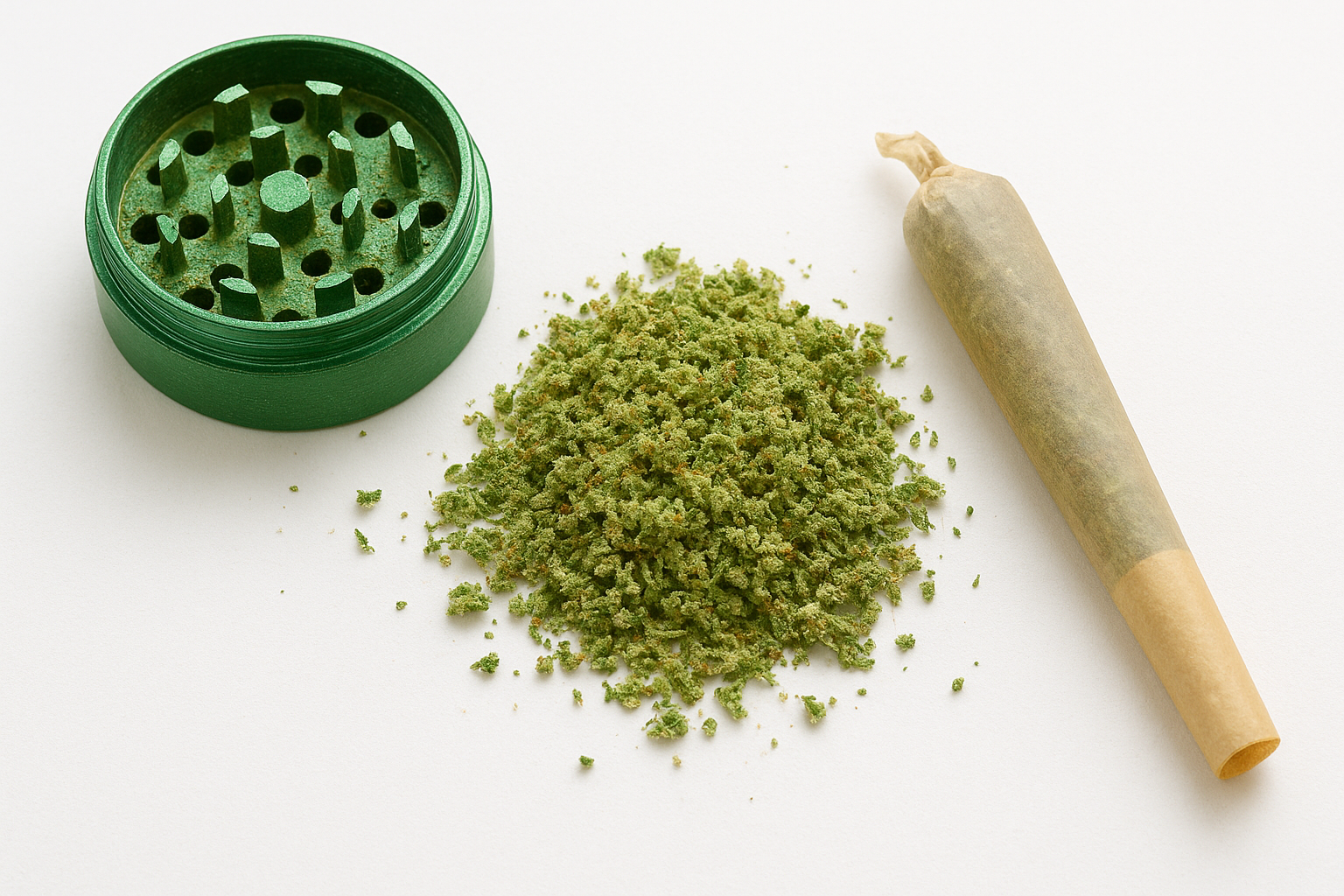
Joints and pre-rolled cones want a medium-fine, fluffy grind, somewhere between loose-leaf tea and finely chopped herbs. You're not aiming for powder. You're aiming for small, even pieces that pack tightly enough to hold their shape but loose enough to let air move through the whole length of the cone. This is the texture that keeps a cherry burning in a straight line instead of curving off to one side and leaving unburned flower behind.
Why cones are less forgiving than bowls
A pre-rolled cone like a RAW cone burns from one end straight through, with no bowl walls or water to buffer uneven density. That means any inconsistency in your grind shows up immediately as canoeing, where one side burns faster than the other and leaves a trench of unburned flower along the paper. Even particle size matters more here than in almost any other method, because the cone's slow-burn paper is designed to combust evenly with flower that's already prepped to do the same.
A cone can only burn as evenly as the grind you pack into it.
How to pack a cone with the right grind
Use this quick checklist before you fill a cone:
- Grind until the texture looks fluffy, not powdery, with no visible chunks bigger than a grain of rice
- Break up any small clumps by hand before loading, since clumps burn slower than the surrounding flower
- Pack in small pinches rather than one big handful, tamping gently after each addition
- Leave the cone slightly springy to the touch instead of rock-hard, since overpacking restricts airflow just as much as an overly fine grind does
- Twist the tip closed only after you've confirmed even density from base to tip
What too fine or too coarse looks like in a cone
Grind too fine for a joint and the paper clogs with compacted dust, making pulls feel restricted even when the cone is lit. Grind too coarse and you get gaps that burn fast in some spots and go cold in others, the classic setup for canoeing. The medium-fine range hits the balance: enough surface area for a clean burn, enough structure for consistent airflow from your first pull to your last.
Ideal grind size for bowls, bongs, and vaporizers
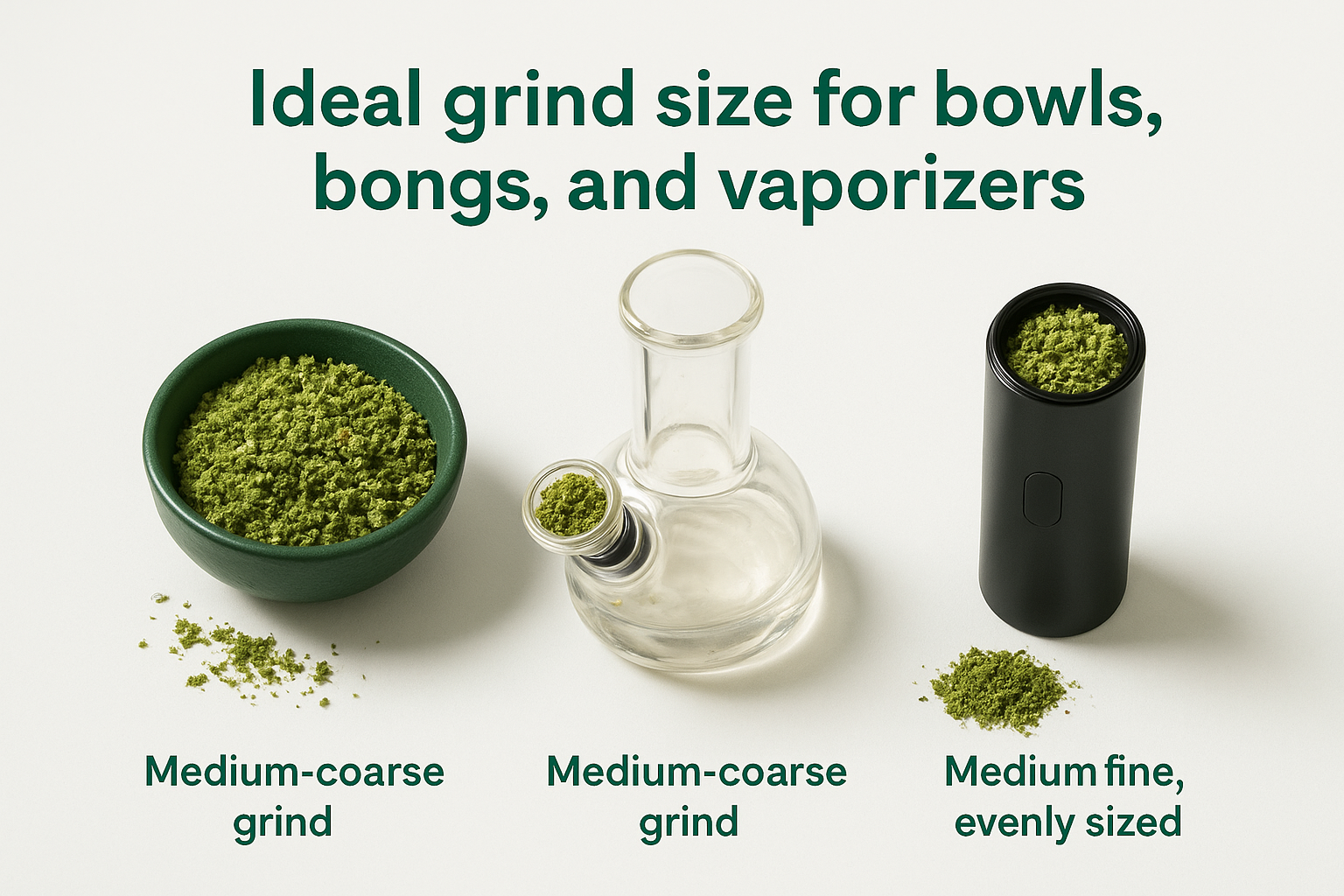
Bowls and bongs give you more room for error than a cone because gravity, water, and the bowl walls all help compensate for uneven texture. A medium-coarse grind, slightly chunkier than what you'd pack into a joint, lets air pull through the bowl without clogging the screen or slipping straight through unlit. Water in a bong cools and filters the smoke regardless of particle size, so you don't need the same fine, even texture a cone demands to burn straight.
Why bowls tolerate a coarser texture
Packing a bowl works differently than packing a cone because you're loading flower into a fixed chamber instead of a long paper tube. Loosely packed, medium-coarse flower lets flame reach the top layer while air still pulls through underneath, giving you a full hit without choking the bowl. Overly fine grind in a bowl or bong tends to get pulled straight through the piece, wasting flower and clogging your downstem or screen with ash and resin.
Bowls forgive a coarser grind because water and gravity do work a joint can't.
Vaporizers need precision, not just fineness
Vaporizers reward a different kind of consistency: a medium-fine, evenly sized grind that maximizes surface area for efficient convection heating without falling through the herb chamber's screen. Unlike combustion, vaporization relies on hot air moving through the material at a controlled temperature, so uneven chunks heat unevenly and waste flower at the center of each piece. According to the FDA, vaporizing herbal material at controlled temperatures changes how compounds are released compared to combustion, which is exactly why grind consistency matters more here than with a lighter and a bowl.
Quick reference for non-joint methods
| Method | Ideal Texture | Why |
|---|---|---|
| Bowl | Medium-coarse | Airflow through packed bowl without clogging |
| Bong | Medium-coarse | Water filtration compensates for uneven pieces |
| Vaporizer | Medium-fine, even | Consistent surface area for convection heating |
Dialing in texture for each tool takes the guesswork out of every session, and once you know the target range for your method, you stop wondering how fine should you grind weed and start adjusting on sight.
Signs you've ground your weed too fine or too coarse
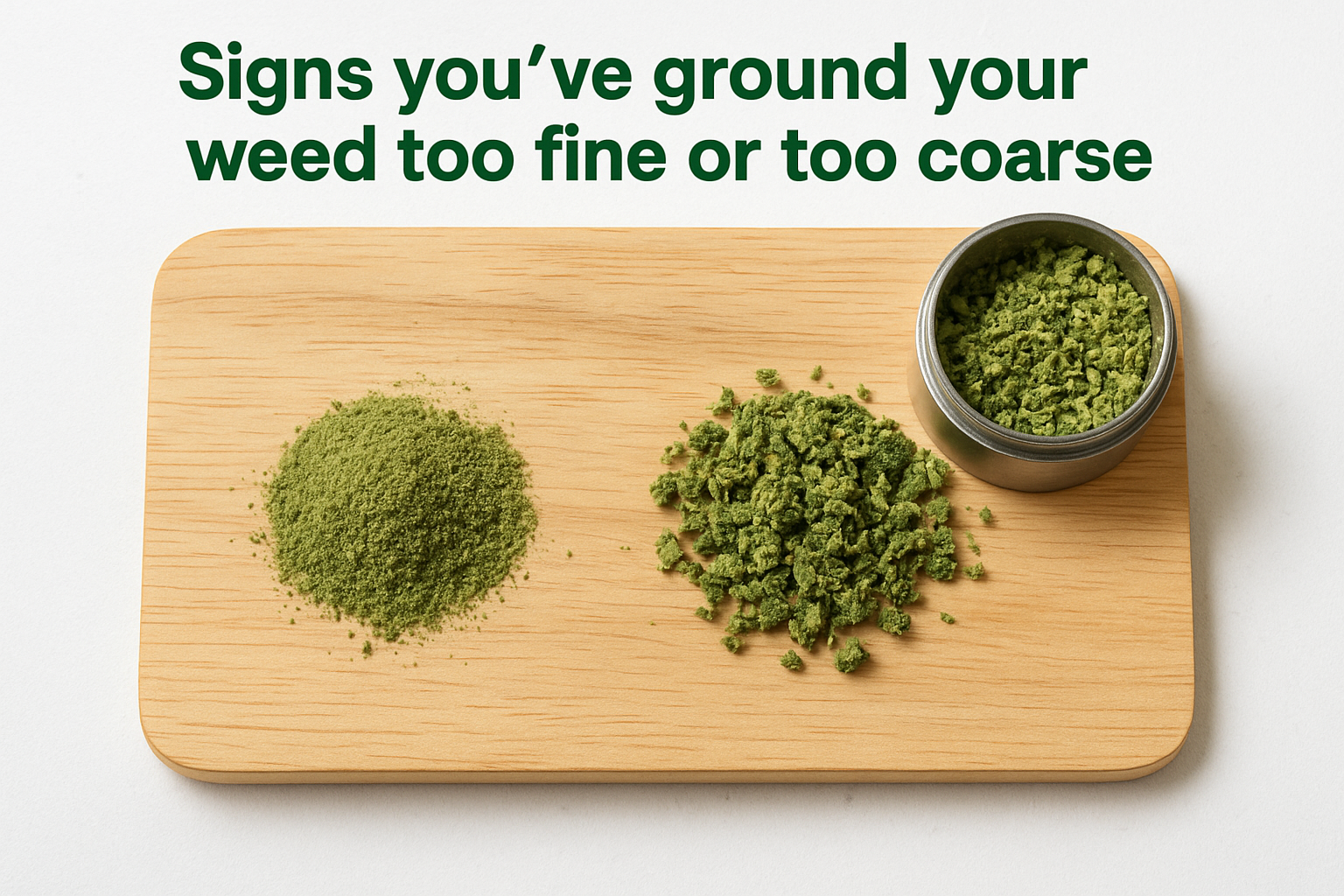
Spotting bad grind size before you light up saves you a harsh session and wasted flower. Most smokers only notice the problem after the joint canoes or the bowl won't pull, but the warning signs show up earlier if you know where to look. Learning to catch over-processed or under-processed flower at a glance turns grinding from guesswork into a quick visual check every time.
Signs your grind is too fine
Fine grind announces itself before you even pack anything. Look for these red flags:
- Texture resembles powder or sand rather than fluffy, separated pieces
- Material clings to your fingers or the grinder walls instead of falling loose
- A joint or cone pulls hard even when freshly lit, signaling a clogged airflow path
- Smoke tastes harsh or ashy on the first few pulls
- Ground flower falls through a bowl screen or bong slit instead of sitting on top
If your grind clumps like flour instead of falling like tea leaves, you've gone too far.
Signs your grind is too coarse
Coarse grind shows up differently, usually as inconsistency rather than a single obvious texture. Watch for:
- Visible chunks larger than a grain of rice mixed in with smaller pieces
- A joint that canoes, burning fast on one side while the other goes cold
- A bowl that needs repeated relighting because the flame can't reach buried material
- Ash that looks dark and unburned rather than light gray
- Hits that feel weak or airy despite a full-looking bowl or cone
Quick fixes once you spot the problem
Neither mistake means you have to toss your flower and start over. Powdery, over-ground material still works fine in a bowl, where water and gravity handle uneven texture better than a joint ever could. Chunky, under-ground flower can go back through a grinder for two or three more short turns, or you can break the biggest pieces apart by hand before repacking. Reworking a bad grind takes thirty seconds and beats smoking through a harsh, uneven session, and it's a habit worth building before you ever load a RAW cone or pack a bowl.
Choosing a grinder that gives you consistent results
A good grinder does half the work of hitting the right texture before you even touch your flower. Cheap plastic grinders wear down fast, crush unevenly, and leave you fighting for a consistent grind no matter how carefully you twist. Investing in a quality grinder with sharp teeth and a proper screen removes most of the guesswork from the question of how fine should you grind weed, because the tool itself does the sorting for you.
Chamber count changes your control
Three or four chambers give you more precision than a basic two-piece grinder. A four-piece design separates coarse flower, sifted kief, and everything in between, so you can pull material out at the exact texture you want instead of grinding everything to one uniform size. Two-piece grinders work fine for a quick coarse grind for a bowl, but they offer no way to catch overground dust before it ends up packed into your joint.
A grinder with a screen sorts texture for you instead of leaving it to chance.
Teeth sharpness and screen quality
Dull teeth tear flower instead of cutting it, which produces the same uneven, stringy mess whether you're using a $5 grinder or one that cost $50. Sharp, diamond-shaped teeth shear buds cleanly into even pieces, while a fine mesh screen below the grinding chamber catches kief without letting whole chunks fall through. Check these before you buy:
- Teeth shape: diamond-cut teeth shear more evenly than blunt pegs
- Screen mesh size: finer mesh catches more kief but can clog faster
- Material: aluminum grinders hold an edge longer than plastic
- Chamber depth: deeper chambers handle larger batches without overpacking
Matching the grinder to what you're rolling
Grinders built for cones and joints should prioritize an even, fluffy output, since that's the texture a slow-burn cone needs to combust properly from tip to end. If you're loading up RAW cones regularly, a grinder that consistently produces medium-fine, separated flower will save you more time and wasted product than any packing trick. Browse Green Blazer's full lineup of cones and accessories to find gear built around that same standard of consistency.
Finding your ideal grind
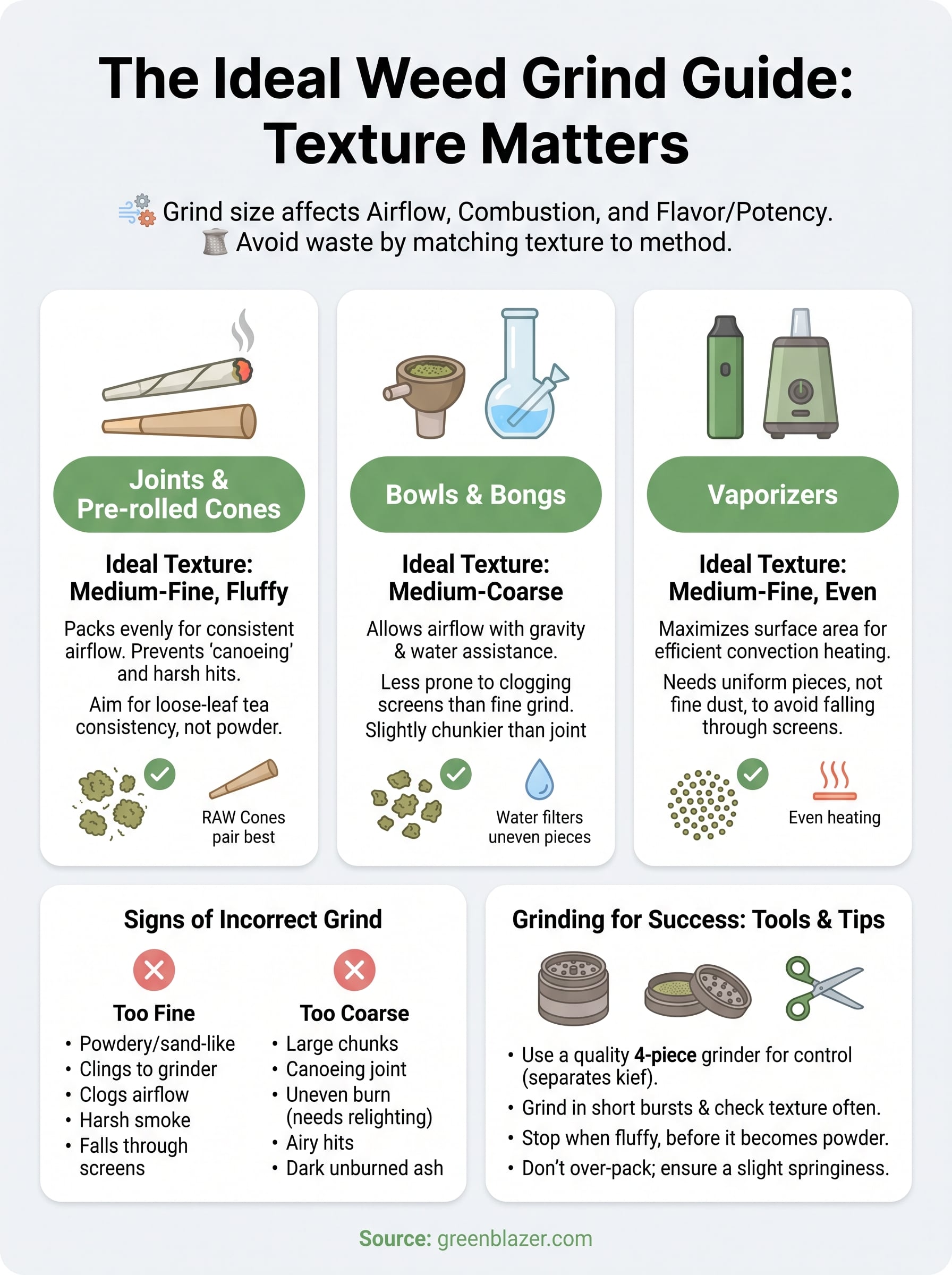
There's no single right answer to how fine should you grind weed, only the right answer for what you're smoking it in. Joints and cones want that fluffy, medium-fine texture that burns straight and even. Bowls and bongs tolerate a coarser grind since water and gravity pick up the slack. Vaporizers split the difference, needing even pieces without the powder. Once you know these targets, grinding stops being a guessing game and becomes a quick visual check every time you pack something.
Getting texture right matters just as much as the flower and papers you're using, so don't let a bad grind undo good product. If you're rolling your own, start with a consistent, medium-fine grind and a paper built for even burns. Check out Green Blazer's RAW cones and grinders to build a setup that gets the texture, and the smoke, right every session.
