

A weed grinder is a small, handheld device designed to break down dry herbs into a fine, even consistency, and it's one of the most underrated tools in any smoker's kit. Whether you're packing a bowl, loading a vaporizer, or filling a pre-rolled cone, ground herb burns more evenly and efficiently than hand-torn chunks every single time.
If you've ever stuffed a RAW cone with unevenly broken flower and watched it canoe halfway through, you already know the frustration a grinder solves. At Green Blazer, we sell RAW cones and smoking accessories built around one idea: a better smoking experience starts with better preparation. A quality grinder is where that preparation begins, and it pairs perfectly with pre-rolled cones for a consistent, smooth session.
This guide covers everything you need to know, what grinders do, the different types available, how to use one properly, and what to look for when buying your first (or next) one.
What a weed grinder does and why it matters
When people ask what is a weed grinder, the simplest answer is this: it's a tool that mechanically breaks dry herb into a consistent, uniform texture through a twisting motion. Two interlocking chambers lined with teeth mesh together when you rotate the top, shredding flower into evenly sized pieces. The result is ground herb that behaves predictably whether you're packing a bowl, loading a vaporizer, or filling a pre-rolled cone.
How grinding changes the way herb burns
Grinding creates a consistent particle size across your entire load, and that uniformity is the foundation of a clean, even burn. When your herb is the same size throughout, air flows through it evenly, heat distributes without hot spots, and the session stays steady from start to finish. You won't see one side burning faster than the other, which is the exact condition that causes canoeing in a joint or pre-rolled cone.
A consistent grind is the single most effective step you can take to prevent uneven burns and wasted herb.
Properly ground herb also stays lit longer with less effort on your part. You don't need to keep relighting or rotating the cone to compensate for uneven packing. The burn takes care of itself because the material underneath is prepared correctly. That reliability becomes especially noticeable when you're using longer formats like King Size cones, where any inconsistency in the fill has more room to compound into a problem.
Surface area and why it matters
Grinding dramatically increases the surface area of your herb. When you break a dense nug into dozens of small, uniform pieces, you expose far more plant material to heat at once. More exposed surface area means more efficient combustion and a fuller burn with less waste sitting at the bottom of your bowl or cone.
This matters across every consumption method. In a vaporizer, increased surface area allows the heating element to work more efficiently at lower temperatures. In a cone or joint, it means you use less herb to get the same result because the burn actually consumes what you've packed instead of leaving charred, underburned clumps behind. Small adjustments in preparation add up to real savings over time, especially for anyone filling cones regularly or in volume.
Why hand-breaking falls short
Hand-breaking flower produces uneven chunks of varying sizes. Large, dense pieces sit next to fine dust and irregular shreds, and that inconsistency creates airflow problems the moment you light up. One section catches and burns fast while another smolders or goes out entirely. You end up spending the whole session managing a burn that a grinder would have prevented from the start.
Beyond the burn quality, hand-breaking is slower and messier. Sticky trichomes coat your fingers, pulling resin off the flower before it ever reaches your cone or bowl. You lose potency, lose time, and still end up with a worse result than you'd get from 10 seconds spent in a grinder. Using a quality grinder keeps those trichomes on the herb itself, where they belong.
A grinder also gives you direct control over the final texture. A few rotations produce a coarser grind suited for cones and joints. More rotations break the herb down finer, which works better for tightly packed pieces or certain vaporizers. Hand-breaking gives you none of that control. You get whatever the nug gives you, and that randomness shows up directly in the quality of your smoke every single time.
Weed grinder types and parts
If you're asking what is a weed grinder in terms of design, the answer depends on how many chambers the device has. Most grinders fall into two-piece, three-piece, or four-piece categories, and that number determines what the grinder can do beyond the basic job of shredding herb. Knowing the difference before you buy saves you from ending up with a tool that doesn't match how you actually smoke.
Two-piece and three-piece grinders
Two-piece grinders are the simplest option: a top lid lined with teeth and a bottom chamber where ground herb collects. They work fine for occasional use, but ground herb mixes back into the teeth during grinding, and you have to empty the chamber manually between every use. Three-piece grinders add a separate collection chamber below the grinding section, with small holes between the two. Once your herb reaches the right particle size, it falls through those holes and sits cleanly in the lower chamber, away from the grinding teeth and ready to pack.
The four-piece grinder
Four-piece grinders are the most popular choice for regular smokers because they include a kief catcher at the bottom. A fine mesh screen separates the collection chamber from a lower compartment, and as you grind, tiny pollen-like particles called kief fall through the screen and accumulate in that bottom layer. Over time, the kief builds up into a concentrated reserve you can use to top a bowl or add to a cone for a stronger session. You collect it without any extra step, just by grinding normally.
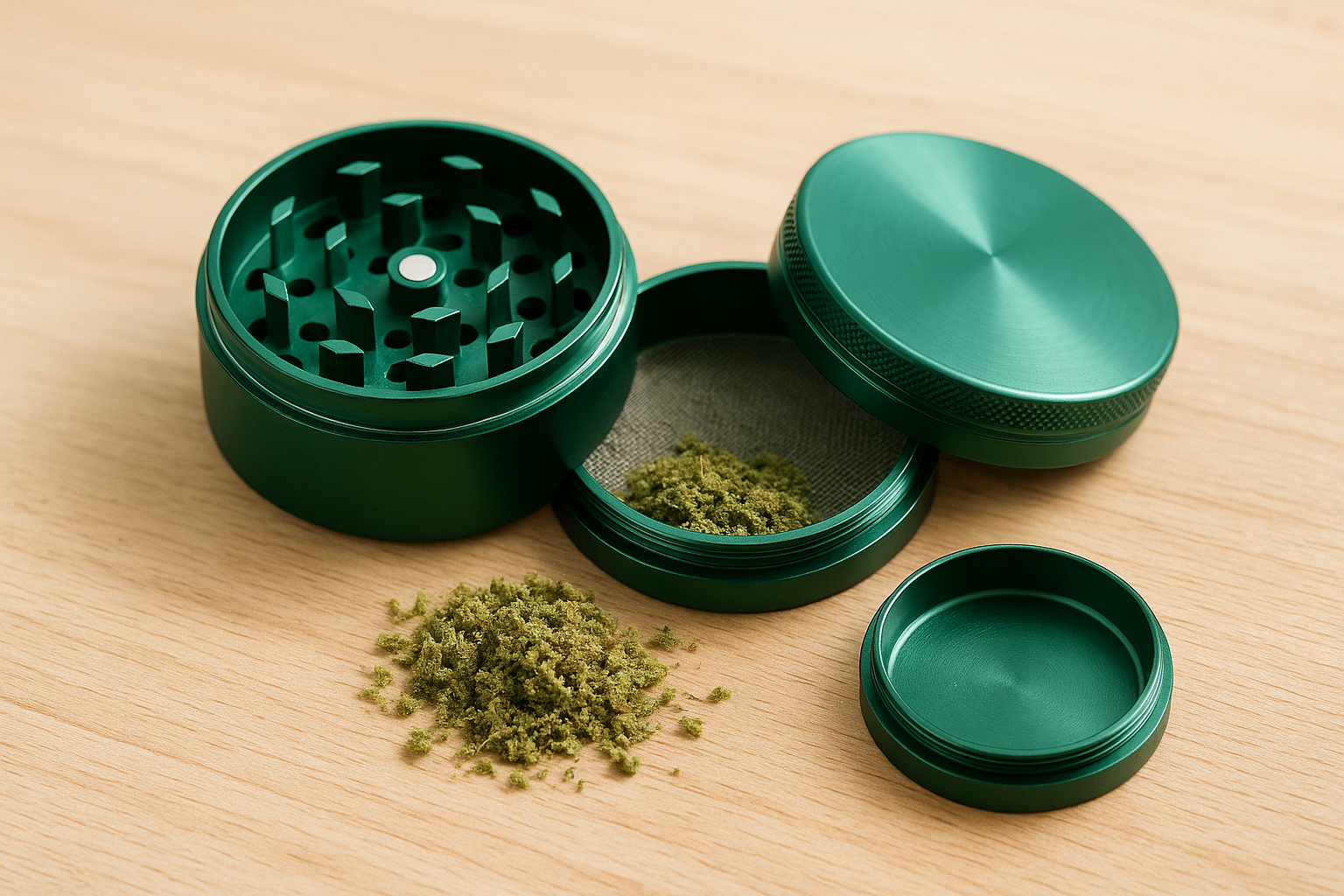
A four-piece grinder gives you both consistent ground herb and a passive kief collection system without requiring any additional effort on your part.
Grinder materials
Metal grinders, most commonly made from anodized aluminum alloy, are the standard for anyone grinding regularly. The teeth keep their shape over time, the threading stays smooth, and the chambers align without wobbling. Anodized aluminum also resists corrosion and cleans easily, which matters once residue starts building up after consistent use. Acrylic and plastic grinders cost less upfront, but the teeth wear down quickly, the threading strips out, and broken plastic pieces can end up mixed into your herb, which creates a real problem.
Wooden grinders have a certain visual appeal, but they absorb moisture and resin, making them difficult to clean thoroughly and prone to developing unpleasant odors. For anyone filling cones with any regularity, a quality metal grinder is the only practical long-term choice.
How to use a weed grinder step by step
Using a grinder correctly takes less than a minute once you understand the process. The technique stays the same regardless of what is a weed grinder you're working with, whether it's a basic two-piece or a four-piece with a kief catcher. Get comfortable with these steps once, and the whole routine becomes automatic before every session.
Loading the grinder
Start by breaking your flower into smaller pieces by hand before placing anything in the grinder. You don't need to go fine here, just rough enough to fit between the teeth without forcing. Remove any stems before loading, since stems tend to bend rather than shred and will wear down your teeth faster than flower does. Place the broken pieces between the teeth of the lower grinding chamber, not in the center hole, because the center post holds the lid in place and does no grinding. Avoid overpacking; filling the chamber about halfway gives the teeth room to rotate freely without jamming mid-grind.
Keeping stems out of your grinder is the single most effective habit for preserving the sharpness of the teeth over time.
Grinding and collecting
Place the lid firmly on the base and apply light downward pressure as you rotate. Ten to fifteen rotations in alternating directions, forward a few turns then backward, breaks up clumps that get caught between teeth and produces a more even result than grinding in one direction only. You'll feel the resistance drop once the herb is fully ground, which tells you to stop. Grinding past that point reduces your herb to a fine powder that packs too tightly, blocks airflow, and makes a cone nearly impossible to draw through.
Once you finish grinding, open the collection chamber and tap the grinder lightly against a firm surface to knock any loose material through the holes. Your ground herb sits ready in the lower section, prepared to load into a cone, bowl, or vaporizer without extra fussing.
Using the kief catcher
If you're using a four-piece grinder, check the kief compartment at the bottom every few sessions. Kief builds up slowly, so the first few uses won't show much, but a noticeable layer develops with consistent grinding over time. Most metal grinders include a small scraping tool specifically for this purpose. Use it to collect the kief from the screen and the bottom chamber and add it directly to a packed cone or on top of a loaded bowl whenever you want a stronger result without using additional flower.
Getting the right grind for joints and cones
Not every smoking format needs the same texture. The number of rotations you apply to your grinder directly controls how fine your herb ends up, and matching that texture to your format is what separates a smooth session from a frustrating one. Understanding what is a weed grinder capable of in terms of output control is just as important as knowing how to load and spin it.
Coarse, medium, and fine: what each grind does
A coarse grind uses fewer rotations, around 5 to 8 full turns, and produces chunky, irregular pieces that work well for dry herb vaporizers with convection heating or for packing a loose bowl where you want slower airflow. Coarse material does not compress tightly, which means air moves through it easily, but it burns unevenly in a cone or joint because the pieces are too large to sit uniformly against each other throughout the fill.
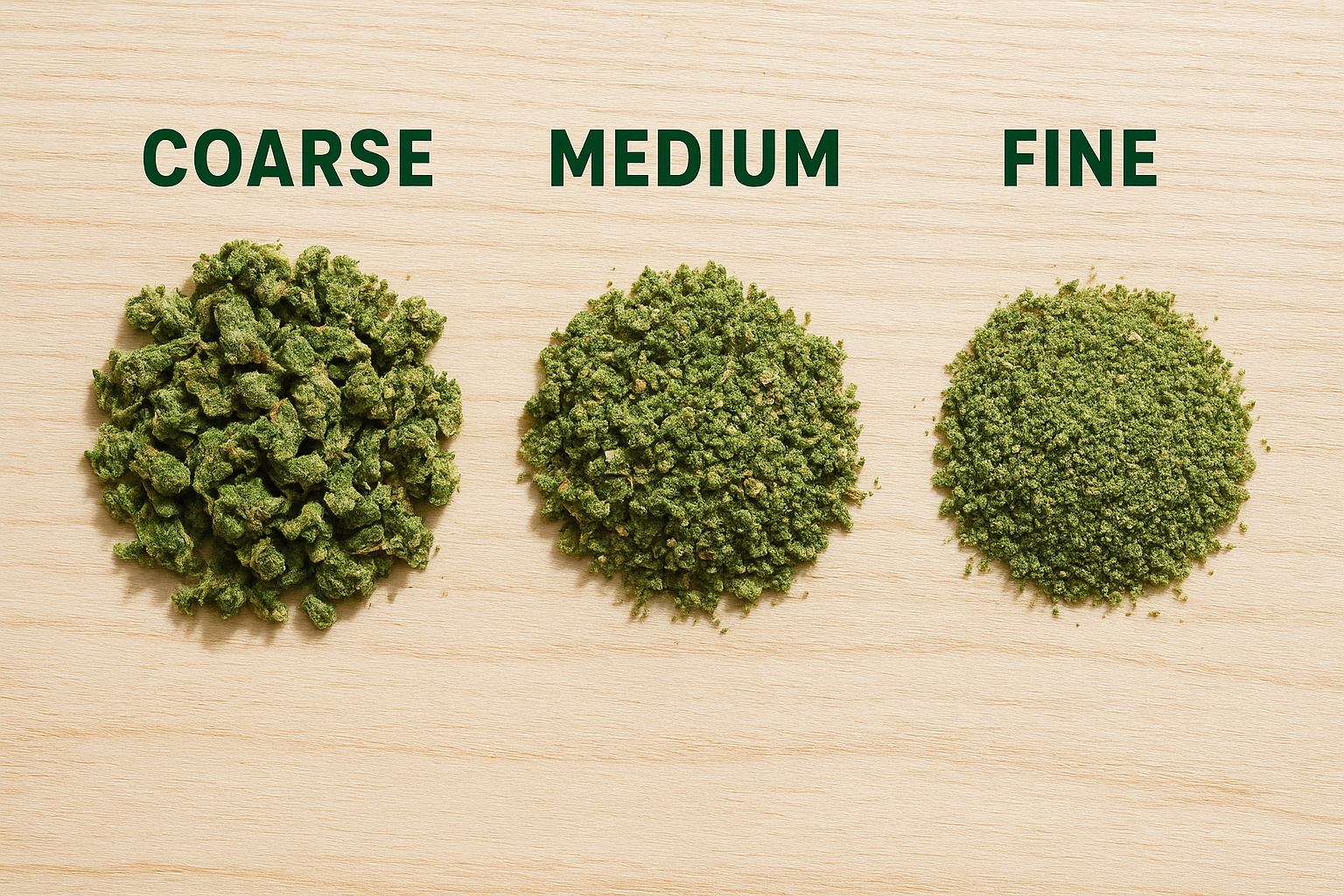
Fine grinds come from 20 or more rotations and reduce herb to an almost powdery consistency. Fine herb packs so densely that it restricts airflow severely, making a draw through a cone laborious or, in some cases, completely impossible. Fine grinds suit certain vaporizers designed for tight packing, but they cause real problems in any paper-based format.
For joints and pre-rolled cones, a medium grind is the target: enough rotations to break the herb fully but not so many that it turns to dust.
Dialing in your grind for cones
A medium grind for cones comes from around 10 to 15 rotations, producing material with a texture that resembles coarse coffee grounds. That consistency packs firmly without compressing into a solid plug, which keeps airflow even from the tip all the way through the body of the cone. RAW cones, especially King Size formats, benefit directly from this grind because the longer fill needs uniform density throughout to avoid running or canoeing during the session.
When you fill a cone after grinding, use a gentle tapping or tamping motion rather than forcing the material down with hard pressure. Medium-ground herb settles naturally with light contact and holds its structure without packing into an airtight wall. If you're using a pre-roll filling machine to load multiple cones, a consistent medium grind feeds through the machine more reliably than coarse chunks or fine powder, cutting down on waste and saving time across a larger batch.
Testing your grind on a small batch first before committing to a full session is always worth the extra minute, especially when you're working with a new strain that may be denser or drier than what you're used to.
Cleaning, storage, and common problems
No matter what is a weed grinder made from, residue builds up inside the chambers and between the teeth after regular use. Sticky resin accumulates on the grinding teeth and along the walls of each chamber, slowing rotation and degrading the quality of your grind over time. Staying ahead of that buildup with regular cleaning keeps your grinder working correctly and protects the herb you put in it.
How and when to clean your grinder
Clean your metal grinder every two to four weeks if you use it daily, or whenever you notice the rotation getting stiff or sticky. Start by disassembling all chambers completely and using a small stiff brush, such as a clean toothbrush or the scraper that comes with most metal grinders, to knock loose the dry residue from the teeth and walls. For a deeper clean, place the disassembled pieces in the freezer for 15 to 20 minutes before brushing. Cold temperatures cause the resin to contract and harden, making it much easier to scrape away without smearing it further into the chamber.
Freezing your grinder before a deep clean is the most efficient way to remove built-up resin without using solvents.
After brushing, soak the metal pieces in isopropyl alcohol at 91% concentration or higher for 20 to 30 minutes, then rinse thoroughly with warm water and let every piece dry completely before reassembling. Never put wet chambers back together, since trapped moisture accelerates corrosion even in anodized aluminum. Avoid using alcohol on any painted or coated surfaces because it strips the finish over repeated applications.
Storage and common grinder problems
Store your grinder in a cool, dry location away from direct sunlight, which degrades both the device and any herb sitting in the collection chamber. A small airtight container or a dedicated storage pouch works well if you travel with your grinder regularly, keeping residue off your bag and protecting the threading from getting knocked around.
The most common problem you'll run into is a grinder that becomes difficult to rotate. That stiff rotation almost always traces back to one of two causes: resin buildup between the threading or the grinding chambers, or a small piece of stem wedged between the teeth. Disassembling and brushing solves both quickly. Cross-threading is the second most frequent issue, and it happens when you align the lid incorrectly and force it closed. Always seat the lid gently and confirm the threading before applying pressure. A cross-threaded grinder needs to be reversed and carefully reseated rather than forced, since forcing it permanently damages the threading.
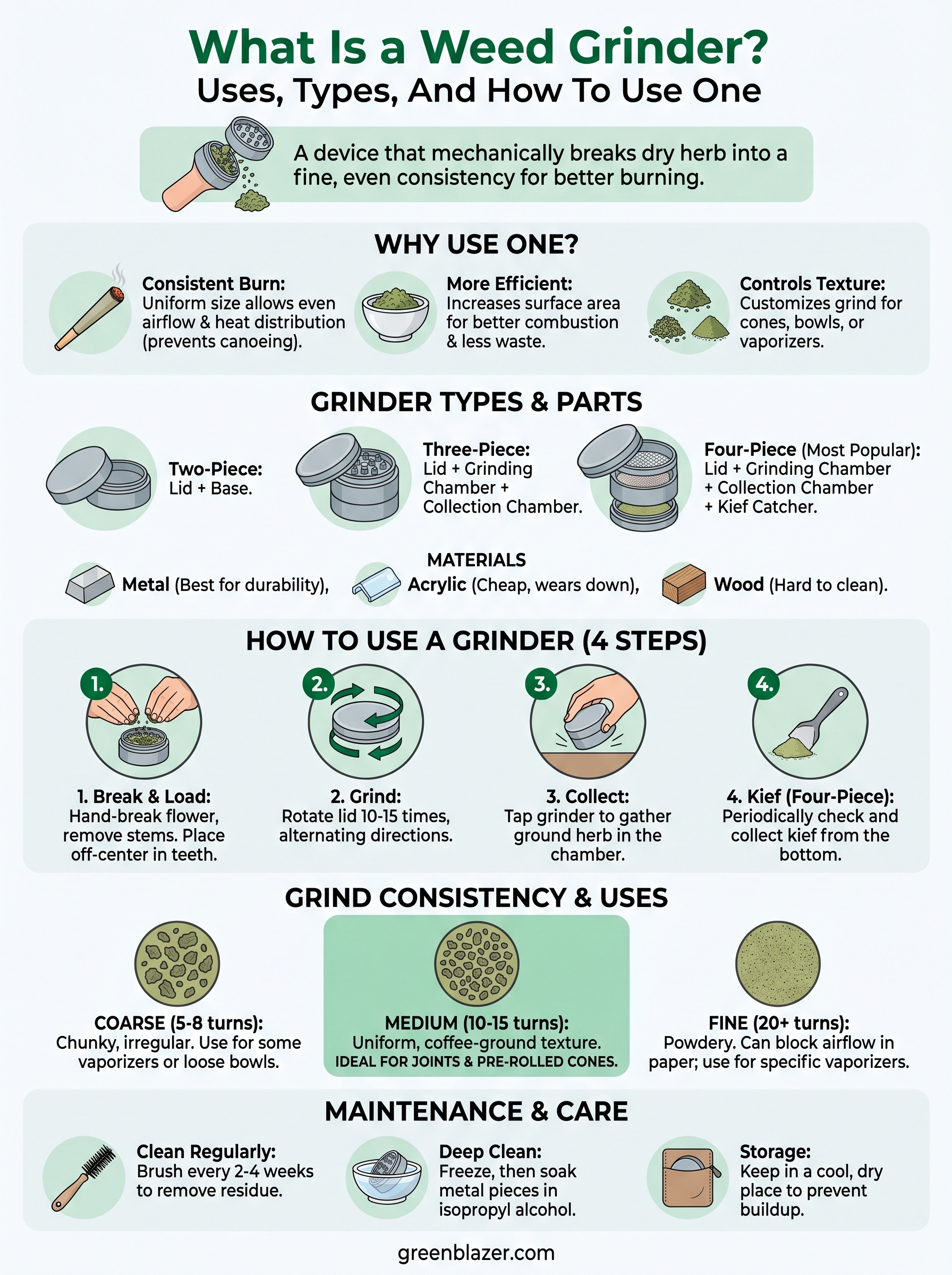
Quick recap and next steps
Now you know what is a weed grinder and exactly why it belongs in your setup. A grinder gives you consistent, uniform herb that burns evenly, reduces waste, and makes every session easier to manage from start to finish. The type you choose, whether a simple two-piece or a four-piece with a kief catcher, shapes what you get out of each grind. Metal construction, a medium grind texture, and regular cleaning keep the tool performing reliably for years without frustrating slowdowns or sticky chambers.
Your grind quality directly determines the quality of your fill, and your fill determines how well your session runs. Pairing a well-ground batch of herb with a quality pre-rolled cone is the fastest way to eliminate the most common smoking problems in one step. If you're ready to put that better grind to use, browse the full selection of RAW pre-rolled cones and smoking accessories at Green Blazer and get everything you need in one place.
