
You've got bud, you've got papers or cones ready to go, but no grinder in sight. It happens more often than you'd think. Maybe you're traveling, maybe your grinder broke, or maybe you just never bought one. Whatever the reason, knowing how to grind weed by hand is a practical skill that every smoker should have in their back pocket. The good news: you don't need any special equipment to get a solid, smokeable consistency.
That said, how you break down your flower matters, especially if you're packing pre-rolled cones. A too-chunky grind leads to uneven burns and wasted herb, while pulverizing it into dust chokes the airflow. At Green Blazer, we've shipped over 100 million RAW cones to smokers and businesses across the country, so we've seen firsthand what good prep looks like before anything gets packed and lit.
This guide walks you through several reliable methods for grinding weed without a grinder, from the classic hand-break technique to a few clever DIY approaches you probably haven't considered. We'll also cover when hand-grinding works great, when it doesn't, and how to get the best results no matter what you're working with.
Why hand-grinding matters for burn and airflow
Most people treat breaking down flower as purely mechanical prep work: get it small, pack it in, light it. But the consistency of your grind directly shapes how your smoke performs, from the first light to the very end. Whether you pack a cone, roll a joint, or load a bowl, particle size and uniformity determine how air moves through the material and how evenly heat distributes. Learning how to grind weed by hand correctly starts with understanding what you're actually trying to achieve before you touch the bud.
Surface area controls your burn rate
When you break flower into smaller pieces, you expose more surface area to the flame at once. More surface area means more material catches heat simultaneously, which produces a steadier, more consistent burn. A large unbroken chunk, by contrast, only ignites on its outer edges while the dense interior stays unlit, wasting both herb and time.
Uniform piece size is what you're really aiming for. If your broken material contains a mix of powder and pea-sized chunks packed together, the fine dust burns off instantly while the large pieces resist combustion. The result is an uneven, patchy burn that forces you to keep relighting. Pieces that are roughly consistent in size burn at a similar rate and carry heat evenly through the whole pack.
The size of your grind matters more than the method you use to get there.
Airflow is the other half of the equation
Picture a packed cone or a rolled joint as a narrow air channel. For smoke to travel from the burning end to your mouth, air needs to move through the packed material with some resistance but without hitting a wall. When pieces are too coarse, large air gaps let combustion happen too fast and the cherry dies out quickly. When the material is packed too fine or too dense, airflow cuts off almost entirely and you get a frustrating, unresponsive draw.
The goal is a medium, even grind that fills the space without sealing it. Machine grinders are popular because they produce repeatable particle sizes automatically. When you break by hand, you have to build that consistency through attention rather than mechanics, which is completely achievable once you know what the right texture looks and feels like.
What a good hand-grind actually looks like
Skip trying to match a machine-perfect result. Your practical target when grinding by hand is pieces roughly the size of a grain of rice, which works across nearly every smoking format including cones, joints, pipes, and bowls. Anything smaller than a sesame seed tends to pack too densely or pull through a screen. Anything larger than a small sunflower seed kernel creates hot spots that burn faster on one side than the other.
A quick visual check after breaking down a bud tells you everything you need to know. Spread your material flat on a clean, smooth surface and scan for obvious outliers: solid chunks, thick stem pieces, or loose powder sitting separate from the rest. Pull the large pieces aside and break them down further. Set obvious powder aside for a bowl rather than a cone, where it would compact at the bottom and restrict the draw. After that 30-second sort, your hand-grind is ready to perform reliably.
Step 1. Clean up and set up your workspace
Before you touch the bud, take 60 seconds to set up properly. A cluttered or sticky surface turns a simple task into a messy one, and you risk losing ground material to cracks, fabric, or a dirty countertop. Your workspace determines how much usable herb you recover, and a clean, flat surface makes every step of how to grind weed by hand faster and more consistent.
Choose the right surface
Not every surface handles broken-down flower the same way. A smooth, flat surface gives you visibility, keeps pieces contained, and lets you push material around without losing any to texture or gaps. Good options include a white ceramic plate, a clean glass cutting board, or a folded sheet of printer paper. White or light-colored surfaces help you spot stems, seeds, and debris sitting in your material before they end up packed into your cone or paper.
A white plate is the simplest, most practical upgrade you can make to your hand-grinding setup.
Here are four surface options and why each works:
| Surface | Why it works |
|---|---|
| White ceramic plate | Smooth, easy to scrape, shows debris clearly |
| Glass cutting board | Non-stick, stays flat, easy to wipe clean |
| Folded printer paper | Portable, lets you funnel material directly into a cone |
| Clean rolling tray | Raised edges contain material and prevent spills |
Remove stems and seeds before you start
Stems and seeds cause two distinct problems. Thick stems produce harsh, woody smoke when they combust, and they create sharp points that can puncture rolling papers or pre-rolled cones from the inside. Seeds can pop or spark when lit, which ruins an otherwise clean session and can scatter hot debris unexpectedly.
Pick through your bud on your chosen surface before you start breaking it down, not after. Run your fingertips along each nug and feel for any hard, rounded seeds sitting inside the bud structure, then snap off visible stems at their base. Discard both into a separate pile. Finishing this step takes about 30 seconds and protects your papers or cones from tearing mid-session. Clean hands matter here too: wash them and dry them completely before you start, since lotion or food residue transfers directly onto your flower and affects the taste.
Step 2. Break buds down by hand without crushing
Now that your surface is clean and your material is sorted, you're ready to break down the bud itself. The most common mistake people make when learning how to grind weed by hand is squeezing and crushing rather than pulling and separating. Crushing compresses trichomes against your skin, which wastes the most potent part of the flower and leaves your fingers sticky while your cone or bowl gets less of what it should.
Use your fingertips, not your palm
Your fingertips give you precise control and minimal contact surface with the flower, which keeps trichome loss as low as possible. Pick up one bud with your non-dominant hand and use the thumb and index finger of your dominant hand to gently pull the bud apart at its natural seam lines. Most buds have visible gaps or crevices where the structure naturally separates, so start there rather than forcing the material apart from the outside.
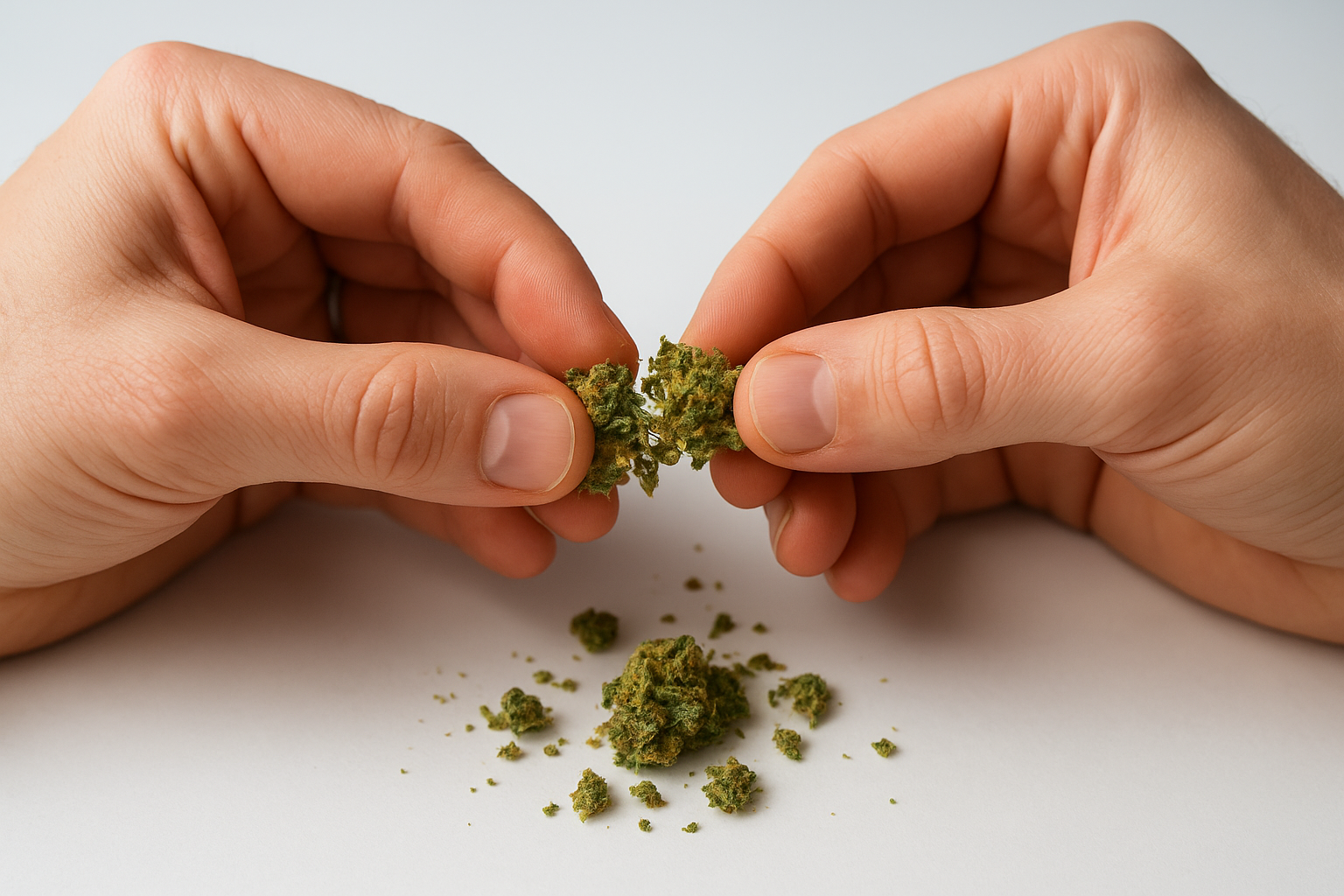
Work with the structure of the bud, not against it.
After the first split, hold each half separately and repeat the pull-and-separate motion. You're not pinching or pressing, just finding the natural break points and opening them up. Keep breaking each piece until you have rough chunks about the size of a grain of rice. Set larger pieces aside to revisit rather than squeezing them harder to force them smaller.
Work from the outside in
Start breaking down the outer petals and looser sections first, since they separate easily and give you quick visual feedback on the size and consistency you're building toward. The dense inner core needs a few extra pull-apart steps before it reaches a workable size, so save it for last rather than tackling it all at once.
Once the outer material is broken down, tackle the dense center by rolling it gently between your thumb and index finger while applying light outward pressure. This loosens the structure without compressing it. Check your pile regularly and spread it flat so you can spot any pieces that still need attention before you move on to packing.
Step 3. Match the texture to your smoking method
Once you have a pile of broken-down material, don't just pack it and assume the result will be the same across every format. Different smoking methods need different textures, and the same hand-broken flower that smokes perfectly in a pipe can perform badly in a pre-rolled cone. Knowing what texture your format requires is the final step in how to grind weed by hand before you pack anything at all.
Cones and joints need a medium, even grind
Pre-rolled cones have a narrow, tapered airway that fills from a wide opening down to a small tip. Too coarse a fill creates air pockets near the wide end that make the cone burn unevenly on one side. Too fine a fill compresses into a dense plug that cuts off airflow before you get a satisfying draw. Your target is pieces roughly the size of a grain of rice, kept consistent throughout the entire fill.
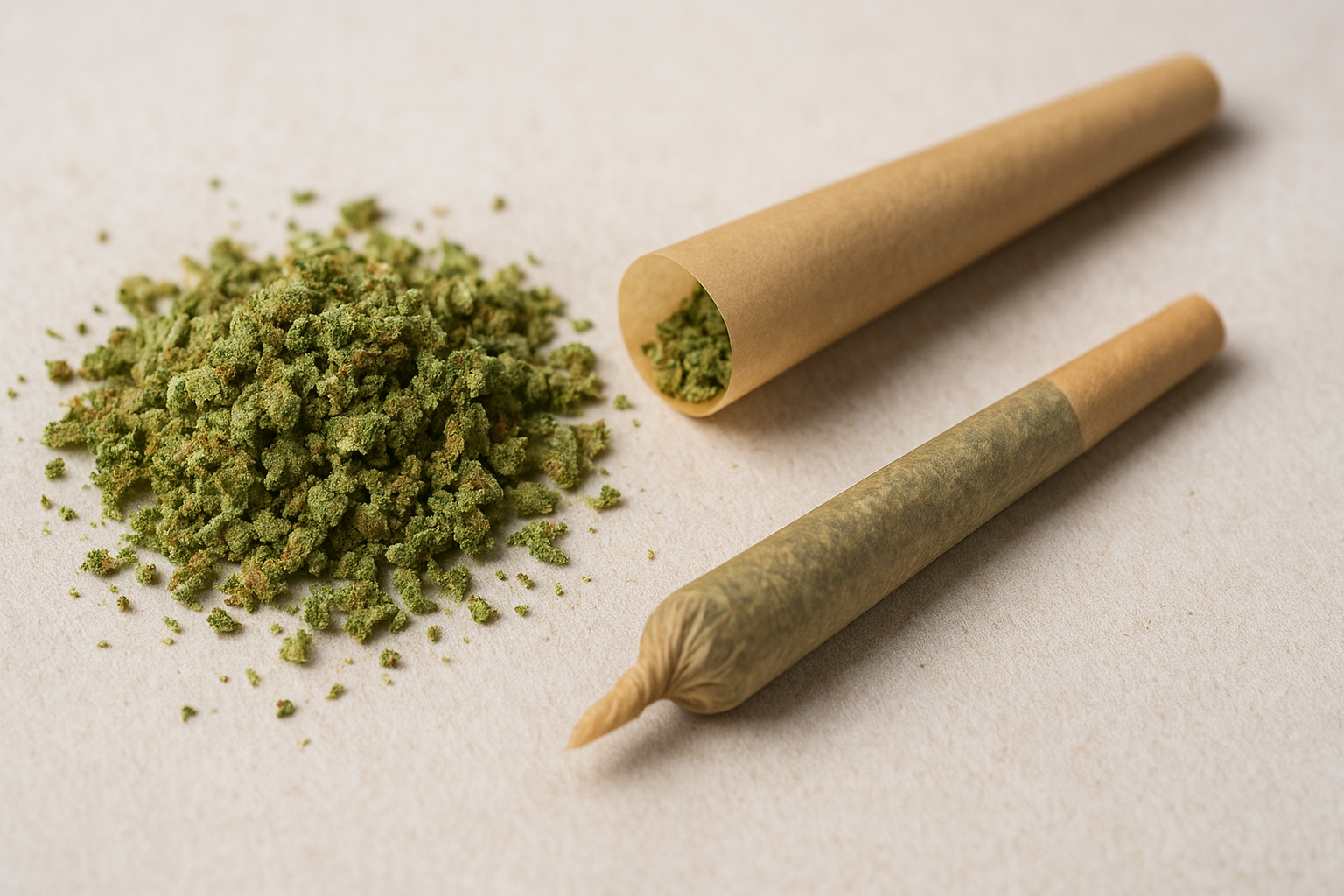
The taper on a cone amplifies any inconsistency in your grind, so uniformity matters more here than with any other format.
For joints rolled with flat papers, the same rice-grain rule applies. Roll the filled paper gently between your fingers to compress the material slightly and identify any large chunks that create obvious bulges. Pick those out and break them down further before you seal the paper, since a thick lump in the middle causes uneven burning along the length of the joint.
Pipes and bowls work with a coarser texture
A bowl has an open chamber with no narrow airway to navigate, which means slightly larger pieces pack and burn cleanly without restricting airflow. You can leave your broken material a bit chunkier here, with pieces up to the size of a small sunflower seed kernel, as long as the chunks stay roughly uniform in size. Avoid packing in loose powder, since fine material pulls straight through the screen or hole at the bottom of the bowl and ends up in your mouth instead of the chamber.
Here's a quick reference for texture by format:
| Smoking Format | Target Piece Size | What to Avoid |
|---|---|---|
| Pre-rolled cone | Rice grain | Powder and large chunks mixed together |
| Rolled joint | Rice grain | Large chunks that bulge and distort the paper |
| Pipe or bowl | Small sunflower seed kernel | Fine powder that pulls through the screen |
| Blunt wrap | Rice grain, slightly finer | Stems that poke through the wrap |
DIY tools that work when you need more control
Pure hand-breaking works well for most situations, but some buds are dense, sticky, or dry in ways that make consistent piece sizes hard to achieve with fingers alone. When that happens, a few household items give you more precision than your fingertips can manage on their own. Each option below takes a different approach to how to grind weed by hand, so pick the one that fits what you have available right now.
Scissors and a shot glass
This is the most reliable DIY method for producing a consistent, medium grind. Drop one or two small buds into a shot glass and use the tips of a pair of clean scissors to snip through the material in short, controlled cuts. The shot glass walls contain the pieces and keep them from scattering across your work surface while you cut.
Snip in different directions rather than straight down repeatedly, since cross-cutting breaks the material more evenly than repeated cuts along the same angle.
Work in short bursts and check the texture every 10 to 15 seconds by tipping the glass slightly and looking at the pieces. Stop cutting once the material reaches a rice-grain consistency, since over-cutting with scissors produces fine dust faster than you might expect. This method works especially well for dry, crumbly flower that tends to collapse unevenly under finger pressure.
A coin and a pill bottle
When your flower is dense and sticky, the coin method lets you break it down without direct hand contact, which keeps trichomes off your fingers and in the material where they belong. Place one or two small broken chunks inside a clean, empty pill bottle, drop in a clean coin, and seal the cap tightly. Shake the bottle firmly for 20 to 30 seconds.
The coin tumbles through the material and breaks dense clusters apart without grinding them into powder, as long as you keep the shaking time short. Open the bottle and check the texture. If large chunks remain, seal it back up and shake for another 10 seconds. Dump the contents onto a white plate, remove the coin, and spread the material flat to check for any outliers before you pack.
| DIY Method | Best For | Watch Out For |
|---|---|---|
| Scissors and shot glass | Dense or sticky buds, consistent medium grind | Over-cutting into powder if you rush |
| Coin and pill bottle | Very dense or resinous flower, minimal hand contact | Over-shaking, which produces fine dust |
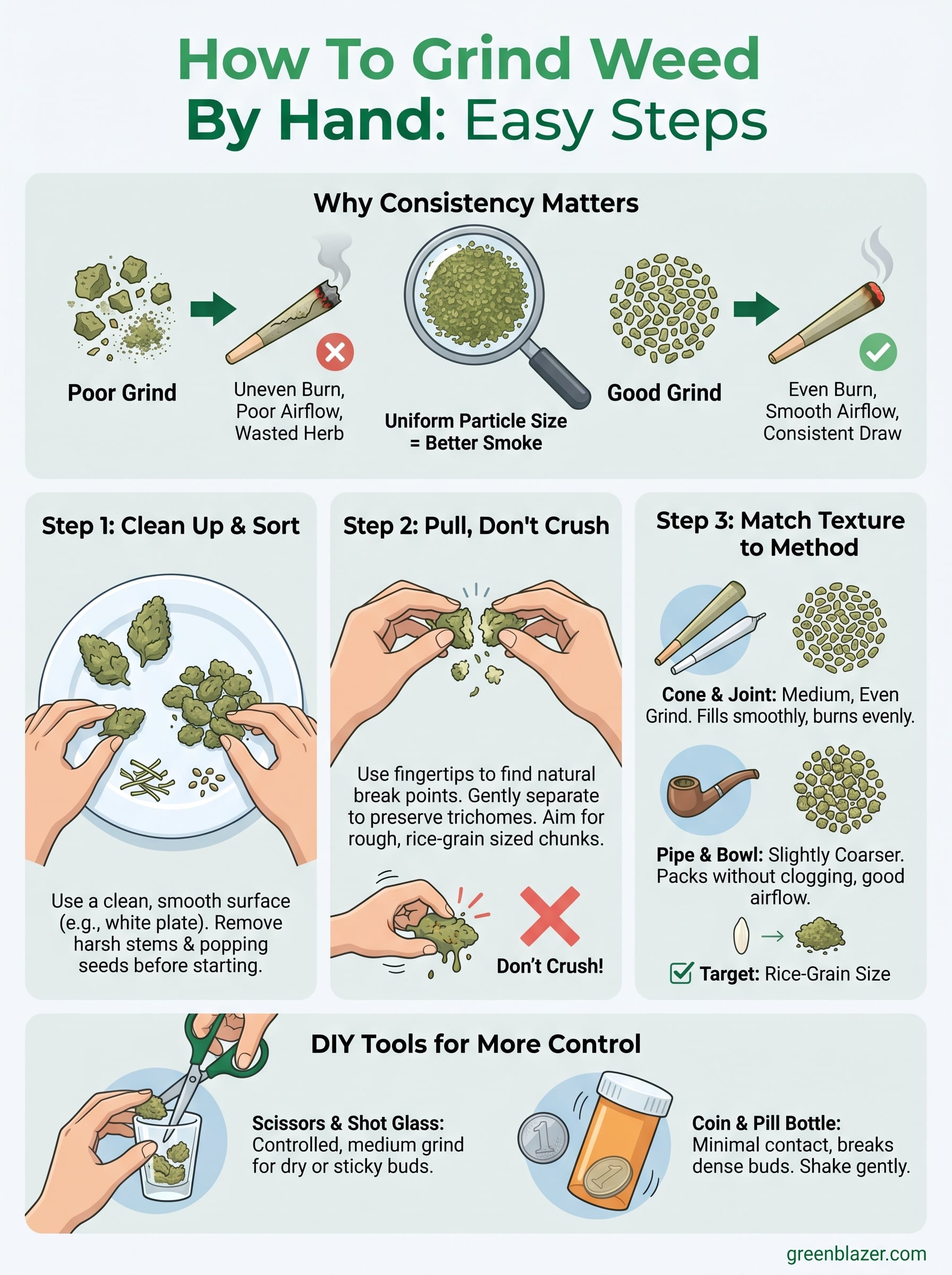
A better hand-grind every time
Knowing how to grind weed by hand gives you a reliable fallback no matter where you are or what tools you have available. The key principles stay consistent across every method: keep your workspace clean, pull apart rather than crush, and match your final texture to the smoking format you're using. Consistent piece size does more work for your burn quality and airflow than any particular technique, so keep checking your material as you break it down and correct outliers before you pack.
Once your material is broken down to the right texture, the cone or paper you pack it into carries the rest. RAW pre-rolled cones fill evenly with a proper hand-grind and produce a slow, clean burn from start to finish. If you're ready to stock up, shop RAW pre-rolled cones at Green Blazer and see why smokers across the country keep coming back.
