

If you've ever tried hand-rolling fifty cones in an evening, you know why a pre-roll machine ends up on every buyer's shortlist sooner or later. Cracked papers, uneven density, and canoeing eat into your product and your patience, whether you're filling cones for personal stash or running a production line that needs to hit daily quotas. The right equipment turns a tedious hand job into a repeatable process.
This list breaks down seven machines worth your money, from a manual pre roll machine that fills a handful of cones at a time to an automated pre-roll machine built for commercial output measured in the thousands. We cover pricing, cone compatibility, batch sizes, and who each option actually fits, so you're not guessing between a hobbyist tray and a full commercial line.
We sell RAW cones by the millions to cultivators and manufacturers, and we hear the same question constantly: which filling machine pairs best with which cone size and count. This guide answers that directly, comparing single-unit fillers against commercial pre roll machines so you can match your volume, budget, and cone type to the right tool before you buy.
By the end, you'll know exactly which machine fits your operation.
1. Green Blazer pre-roll filling machines
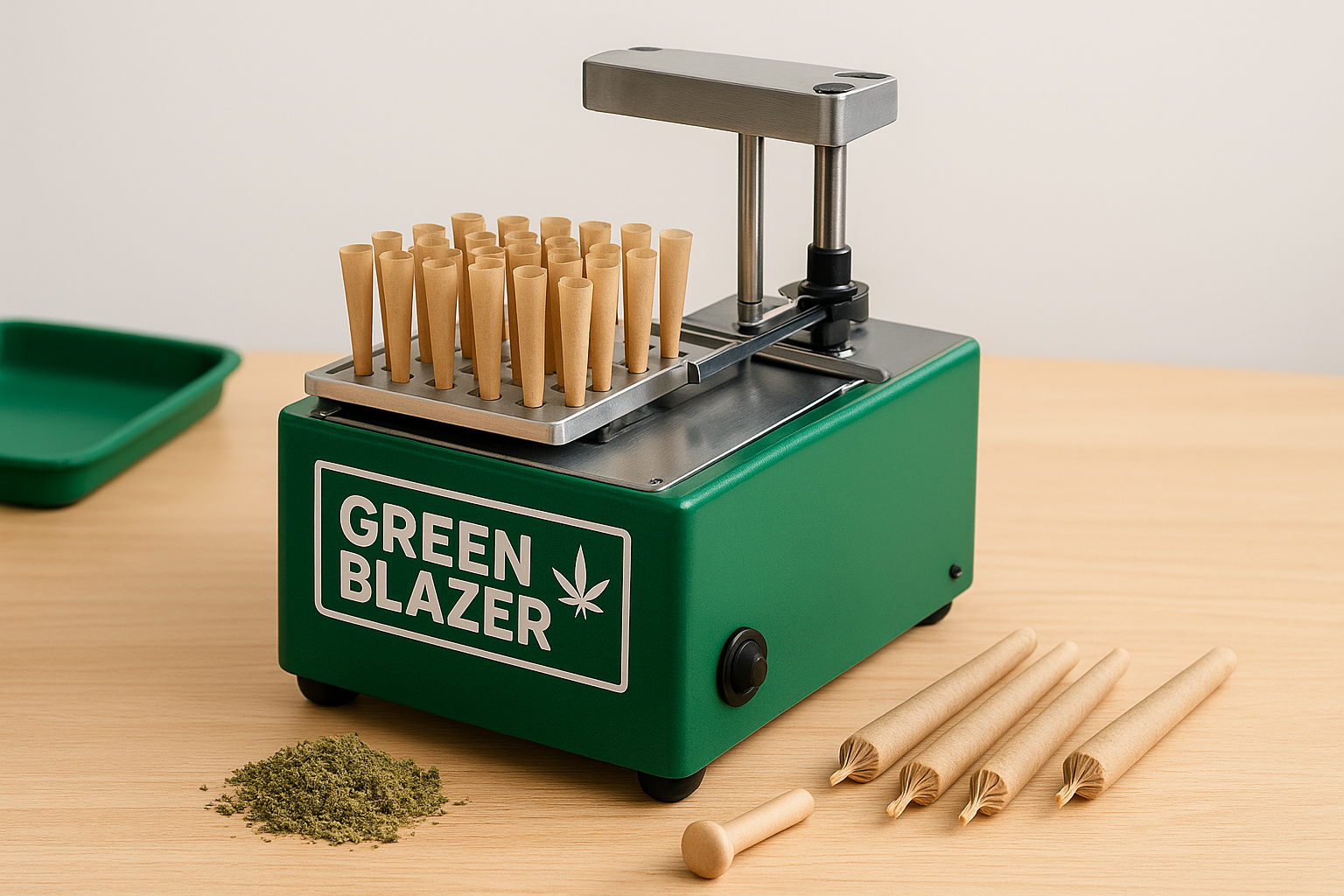
Our own lineup at Green Blazer covers the range from countertop hobbyist units to full commercial fillers, and we built it because we kept hearing the same complaint from customers: most pre roll machine for sale listings only fit one cone size or one batch scale. Ours don't. We sell RAW pre-rolled cones in every size by the truckload, so we designed our filling machines around the exact cone specs we distribute, meaning zero guesswork about fit or gum line compatibility.
How it works
Each machine uses a cone-loading tray system: you drop empty RAW cones into pre-set slots, load your ground material on top, and either hand-pack with the included tamping tool or run the vibration plate to settle material evenly through the cone. The vibration mechanism is the part people notice first, since it eliminates the air pockets that cause canoeing and uneven burns. For the manual models, you finish by twisting the cone tips closed by hand. The automatic versions add a folding arm that crimps and twists the tip mechanically, so you're not touching a single cone after loading.
A filling machine only earns its price tag if it stops canoeing, and that's the one metric worth testing before you buy.
Best for
These machines suit almost everyone in our audience, which is intentional. If you're an individual consumer tired of hand-rolling and want a manual pre roll machine for weekend batches, the entry tray models work. If you're a licensed cultivator or co-packer filling thousands of units a week, our commercial-tier units handle that volume without swapping equipment, and our wholesale cone application covers the bulk supply side. We built the lineup as a ladder, so you can start small and upgrade the same cone compatibility as your output grows.
Capacity and speed
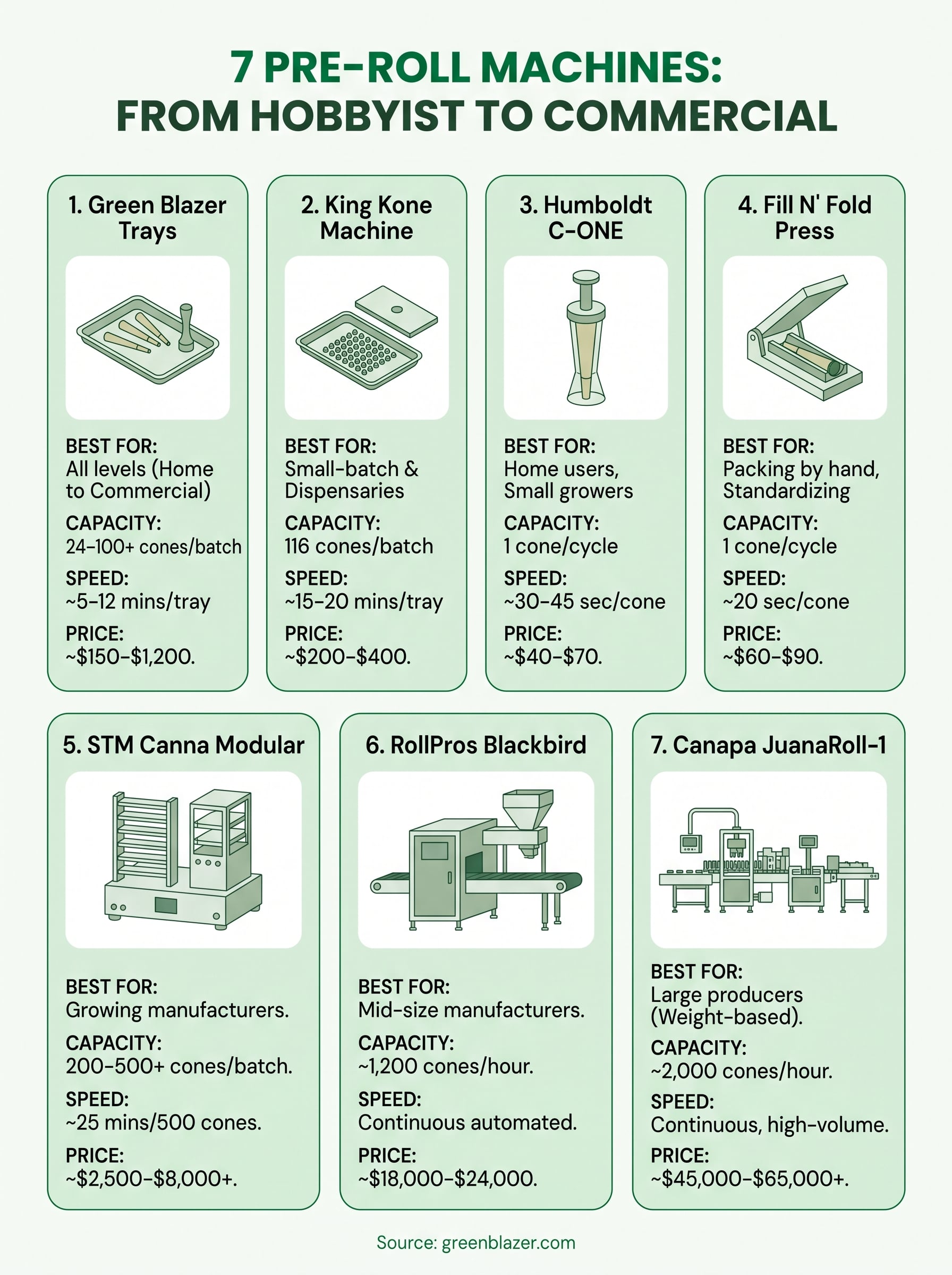
Our trays start at 24-cone batches for home and small-shop use, scaling up to 100-plus cone trays for commercial runs. A trained operator fills a 100-cone tray in roughly 8 to 12 minutes on the manual units, and the automated crimping model cuts that closer to 5 minutes per batch once you're past the learning curve.
Price range
Pricing runs from around $150 for the basic hobbyist tray kit up to $1,200 for the full automated commercial unit with crimping arm. You can see current models and specs on our cone filling equipment page, including bundle pricing when you order machines alongside bulk RAW cones.
2. King Kone cone filling machine
King Kone built its name as one of the earliest dedicated pre roll joint machine brands on the market, and a lot of small dispensary brands cut their teeth on this equipment before scaling up. It's a straightforward cone-loading system that skips the bells and whistles in favor of a design that just works batch after batch.
How it works
You load empty cones into a perforated loading plate, pack ground flower on top, then run the unit's shaking mechanism to distribute material down through the cone without crushing the paper. A separate pressing plate compacts the fill, and you twist the tips closed by hand afterward. There's no automated crimping arm here, so it sits closer to a semi-manual pre rolled cones machine than a fully hands-off system.
A machine that skips automation but nails consistent packing beats a flashy one that jams every third cone.
Best for
King Kone suits small-batch producers and dispensary back rooms that need reliable output without investing in a full commercial line yet. It's a solid step up from hand-rolling for anyone testing product-market fit before committing to bigger equipment.
Capacity and speed
The standard plate handles 116 cones per batch, and most operators report filling a full tray in about 15 to 20 minutes once they've learned the shake-and-press rhythm. That's slower than fully automated units but still a massive jump over rolling by hand.
Price range
Expect to pay between $200 and $400 depending on the plate size and accessory bundle you choose, putting it squarely in the mid-range pre roll machine commercial category for growing operations.
3. Humboldt C-ONE single cone filler
Humboldt Company built the C-ONE around a simple idea: not everyone needs a tray that fills a hundred cones at once. This single pre roll machine targets the grower or hobbyist who wants consistent, canoe-free cones one at a time, without buying commercial equipment they'll never fully use.
How it works
You insert one empty cone into the C-ONE's chamber, pack ground material through the top funnel, and use the built-in plunger to compress the fill in stages. The design forces material down in layers rather than one dense plug, which is what keeps the burn even from tip to base, the same principle behind how packing density impacts burn quality. There's no vibration plate here, so it's a purely manual, hands-on pre roll machine for sale aimed at precision over speed.
A single-cone filler trades speed for control, and for small batches, control wins every time.
Best for
The C-ONE fits home users, medical patients rolling their own supply, and small-scale growers who want quality over volume. It's also a good training tool if you're teaching new staff proper packing technique before moving them onto a commercial tray system, since the manual plunger makes bad habits obvious fast.
Capacity and speed
This unit processes exactly one cone per cycle, and most users report about 30 to 45 seconds per cone once they've got the plunger technique down. That works out to roughly 60 to 80 cones per hour with steady hands, which sounds modest until you compare it to rolling by hand.
Price range
The Humboldt C-ONE typically retails between $40 and $70, making it one of the cheapest entry points into machine-filled cones on this list, and a reasonable starting point if you're not ready to commit to batch equipment yet.
4. Fill N' Fold manual pre-roll press
Fill N' Fold takes a different approach than the tray-and-shake designs above, and it shows up often in roundups of the best joint rolling machines. Instead of vibration, this manual pre roll machine relies on a hinged press that folds around a pre-loaded cone and compresses it in one motion. It's built for shops that want a tactile, low-tech option without sacrificing consistency batch to batch.
How it works
You pack the cone by hand first, filling it loosely with ground material, then set it into the press's cradle. Closing the hinge applies even pressure along the entire length of the cone rather than just the top, which is what separates this pre rolled cones machine from basic tamping tools. A built-in guide keeps the cone straight during the press, preventing the crushed-tip problem that shows up when people push too hard with a plain rod.
Even pressure along the whole cone beats a hard push at the tip every single time.
Best for
This press fits people who already pack cones instead of rolling joints reasonably well by hand but want a tool that standardizes the final compression step. It's popular with home users and small dispensary counters that fill a dozen or two cones a day and don't need a tray system.
Capacity and speed
Fill N' Fold handles one cone per press cycle, and each cycle takes about 20 seconds once you've packed the cone. That puts realistic output around 100 to 120 cones per hour for someone working steadily, assuming the packing step happens off to the side.
Price range
The press typically sells for $60 to $90, making it a budget-friendly middle step between a plunger tool and a full tray-based filling system.
5. STM Canna modular pre-roll systems
STM Canna built its reputation on modular hardware that scales with your business, and its pre-roll line follows the same philosophy. Instead of picking one fixed tray size, you buy a base unit and add filling modules as your commercial pre roll machine needs grow, which makes it a favorite among mid-size manufacturers who don't want to replace the whole rig every time they scale up.
How it works
The system pairs a cone-loading rack with a separate vibration-and-compression module that clips onto the base frame. You load cones into the rack, attach the module, and run a timed vibration cycle that packs material evenly before a pneumatic press finishes the compression. Because the modules are interchangeable, you can swap in a different rack size without buying an entirely new machine, which is the main thing that separates this pre rolled cones making machine from fixed-tray competitors.
Modular hardware means your equipment grows with your order volume instead of getting replaced by it.
Best for
This system fits growing manufacturers and co-packers who expect volume to increase over the next year or two but don't want to overspend on capacity they don't need yet. It's less useful for hobbyists, since the modular design carries a price premium that only pays off at scale.
Capacity and speed
Base racks start at 200 cones per cycle, with add-on modules pushing capacity past 500 cones per run. A trained crew running the full setup can complete a 500-cone batch in about 25 minutes, putting daily output in the tens of thousands with a two-shift operation.
Price range
Base units start around $2,500, with additional modules priced between $600 and $1,800 depending on capacity, so a fully built-out system commonly runs $5,000 to $8,000.
6. RollPros Blackbird automated roller
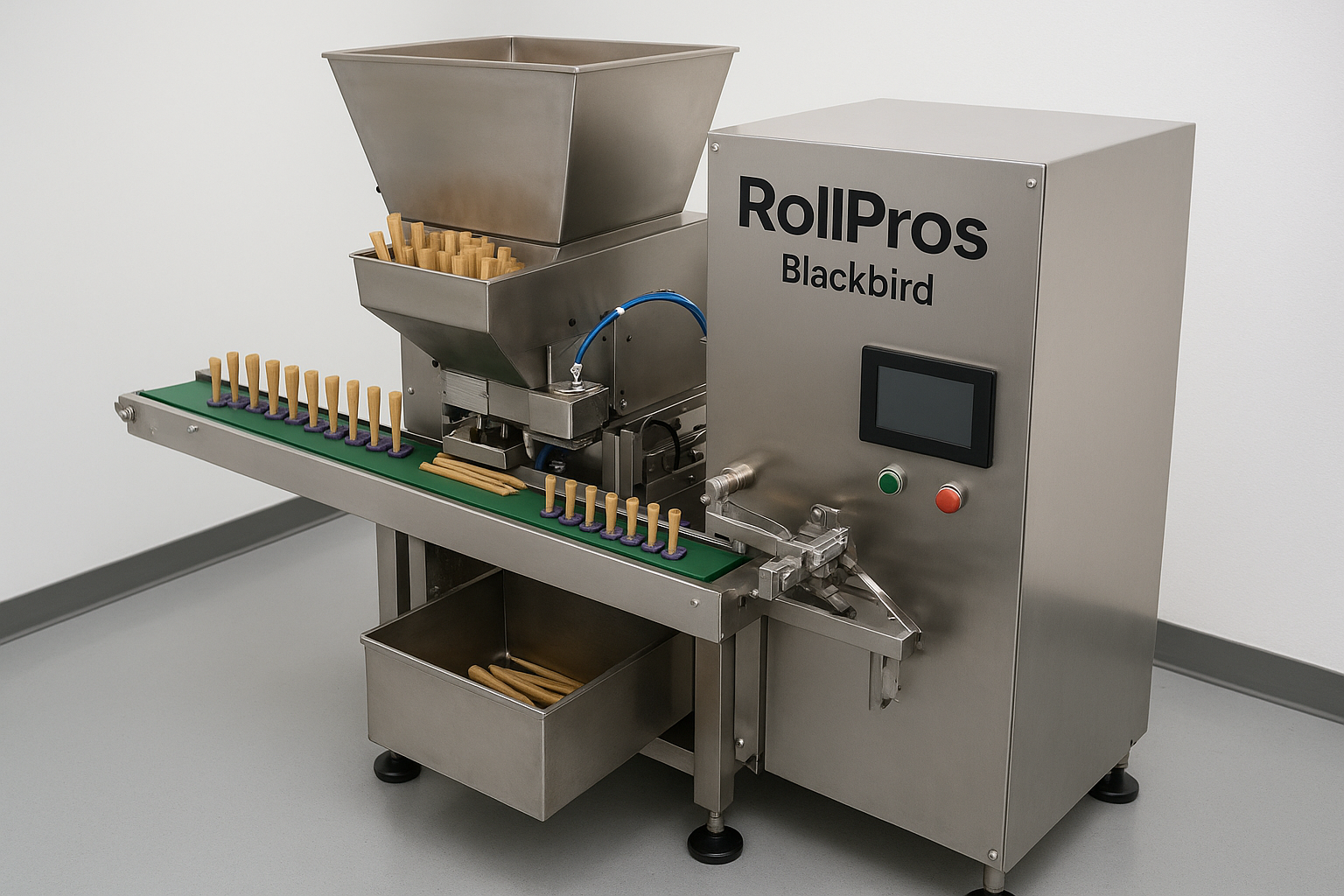
RollPros built the Blackbird as a true automated pre-roll machine, meaning it handles loading, packing, and closing without an operator touching individual cones after setup. It's the kind of unit that shows up in mid-size manufacturing facilities that outgrew tray systems but aren't ready for a full production line costing six figures.
How it works
The Blackbird feeds empty cones from a hopper onto a conveyor, where a dosing head deposits a measured amount of ground material into each one. A vibration station settles the fill, then a rotating arm crimps and twists the tip before the finished cone drops into a collection bin. Operators mainly monitor hopper levels and clear the occasional jam rather than handling product directly, which is what separates this joint pre roll machine from the semi-manual trays covered earlier in this list.
Once a machine handles loading and closing on its own, your labor cost per cone drops the most.
Best for
This unit suits manufacturers running consistent daily volume who need to cut labor hours without jumping straight to a full commercial line, especially in tight markets like California's pre-roll market. Cultivators and co-packers filling several thousand cones a day get the most value here.
Capacity and speed
The Blackbird processes roughly 1,200 cones per hour at rated speed, translating to close to 9,000 cones across a standard shift once you account for hopper refills and quality checks.
Price range
Expect to pay between $18,000 and $24,000 depending on dosing head configuration and cone size compatibility, and it pairs well with backrolled king size cones in 800 count boxes built for commercial machines.
7. Canapa JuanaRoll-1 automatic system
Canapa rounds out this list with the JuanaRoll-1, a full-scale automatic pre roll machine built for facilities that need continuous output rather than batch runs. It's the highest-volume option here, and Canapa markets it directly at licensed producers running multiple shifts, not at shops dabbling in bigger equipment for the first time.
How it works
The JuanaRoll-1 runs as an integrated line: cones load from a magazine feeder, a metering system doses ground material by weight rather than volume, and a dedicated pre roll vibration machine module packs each cone before a servo-driven crimper seals the tip. Because dosing is weight-based, output stays consistent even when flower density varies batch to batch, which is the detail that separates it from cheaper volumetric fillers.
Weight-based dosing beats volume-based fillers whenever your flower density shifts from batch to batch.
Best for
This system fits large cultivators, co-packers, and manufacturers already running six-figure production budgets who need consistent dosing accuracy across huge batches. It's overkill for anyone below a few thousand cones a day, and Canapa doesn't really market it otherwise.
Capacity and speed
Rated output sits at roughly 2,000 cones per hour, and a two-shift facility can clear 25,000 to 30,000 cones daily once staff know the calibration routine and jam-clearing steps.
Price range
Pricing starts around $45,000 and climbs past $65,000 with additional dosing heads and packaging integration, placing the JuanaRoll-1 firmly in enterprise territory compared to every other machine on this list.
Matching the machine to your production needs
Your cone count tells you almost everything you need to know before you spend a dollar. Weekend rollers filling a few dozen cones do fine with a plunger tool or manual press, while shops moving hundreds a day need a vibration tray at minimum, and a quick RAW cone size quiz settles which cone you're loading into it. Cultivators and co-packers pushing thousands daily should skip straight to automated or modular systems, since labor savings pay for the equipment fast at that volume, and it helps to know where to buy RAW cones in bulk to feed them.
Budget matters just as much as batch size. Don't buy a $20,000 automated roller if you're filling 50 cones a week, and don't stay stuck hand-packing if you're already running a commercial operation. Match the machine to where your business sits today, with room to grow into the next tier.
If you're still narrowing down which pre-roll machine fits your setup, or you need RAW cones sized to match whatever you buy, browse our electric and manual pre-roll rolling machines and bulk cones.
