

Whether you're loading up a RAW cone for a chill evening or picking out a strain at your local dispensary, you've probably asked yourself: sativa vs indica, which is better? It's one of the most common questions in cannabis, and the answer isn't as straightforward as most people think. Each type brings a distinct set of effects, from energy and focus to deep relaxation and sleep, and what works best depends entirely on what you're after.
At Green Blazer, we sell millions of RAW pre-rolled cones every year to both individual smokers and commercial producers across the country. We see firsthand how much the strain you choose shapes the experience, and how the right cone paired with the right flower makes all the difference. That's why we put together this guide, to give you a real, practical breakdown of sativa and indica so you can make a more informed choice.
Below, we'll cover the key differences in effects, how each type performs for sleep and anxiety, what science actually says about the sativa-indica divide, and how to figure out which one fits your lifestyle. No filler, just the information you need to pick the right strain for your next session.
Why the sativa vs indica question matters
When you walk into a dispensary or browse a cannabis menu online, sativa and indica are typically the first two categories you encounter. Budtenders use them constantly, product labels lead with them, and most buyers make their initial choice based on them. The sativa vs indica framework has become the default language of cannabis selection, which is exactly why understanding what it means, and where it breaks down, matters more than most people realize.
How the labels became the standard
The original distinction between sativa and indica comes from 18th-century plant taxonomy. Sativa plants tend to grow tall and narrow with lighter leaves, while indica plants grow shorter and bushier with darker, wider leaves. These were structural descriptions meant to classify plant species, not predict how they would make someone feel. Somewhere along the way, the cannabis industry adopted these physical labels and attached behavioral effects to them: sativa for energy and creativity, indica for relaxation and sleep.
The sativa/indica split was built on plant anatomy, not pharmacology, and that gap between origin and popular use is where most of the confusion starts.
The industry ran with this framework for decades because it gave consumers a simple mental model for making decisions quickly. If you wanted to stay alert and social, you picked a sativa. If you needed to wind down after a long day, you reached for an indica. The shorthand stuck because it was convenient, not because the underlying science fully supported it.
Why the question still matters despite its limits
You're right to ask the sativa vs indica which is better question, even if the answer turns out to be more nuanced than a two-category system suggests. Knowing how these terms are used in stores, on product packaging, and in conversations with growers helps you navigate the market far more effectively. Ignoring the framework entirely puts you at a real disadvantage when you're trying to communicate what kind of experience you're after.
The sativa-indica divide does point toward genuine chemical and genetic differences between cultivars, even if those differences don't map perfectly onto "energizing" or "sedating." Sativa-leaning strains tend to carry different terpene profiles than indica-leaning ones, and those terpenes shape your experience in measurable ways. Understanding the framework gives you a practical starting point, and knowing its limits helps you make sharper decisions the more experience you build.
What this means for your buying decisions
Most consumers fall into one of two traps: they either treat the sativa/indica labels as absolute rules or they dismiss the categories entirely after learning the science is messy. Neither approach serves you well. The labels are imperfect signals, not guarantees, and treating them as rough guides while digging deeper into specific strain data gets you closer to the experience you actually want.
What actually drives effects: THC, CBD, terpenes
If you're trying to answer sativa vs indica which is better for your situation, you need to look past the plant labels and understand what's actually inside the flower. The real drivers of your experience are three compounds: THC, CBD, and terpenes. These are the variables that determine whether a session leaves you energized, calm, anxious, or half-asleep on your couch, not whether the plant grew tall or short.
THC and CBD: the primary drivers
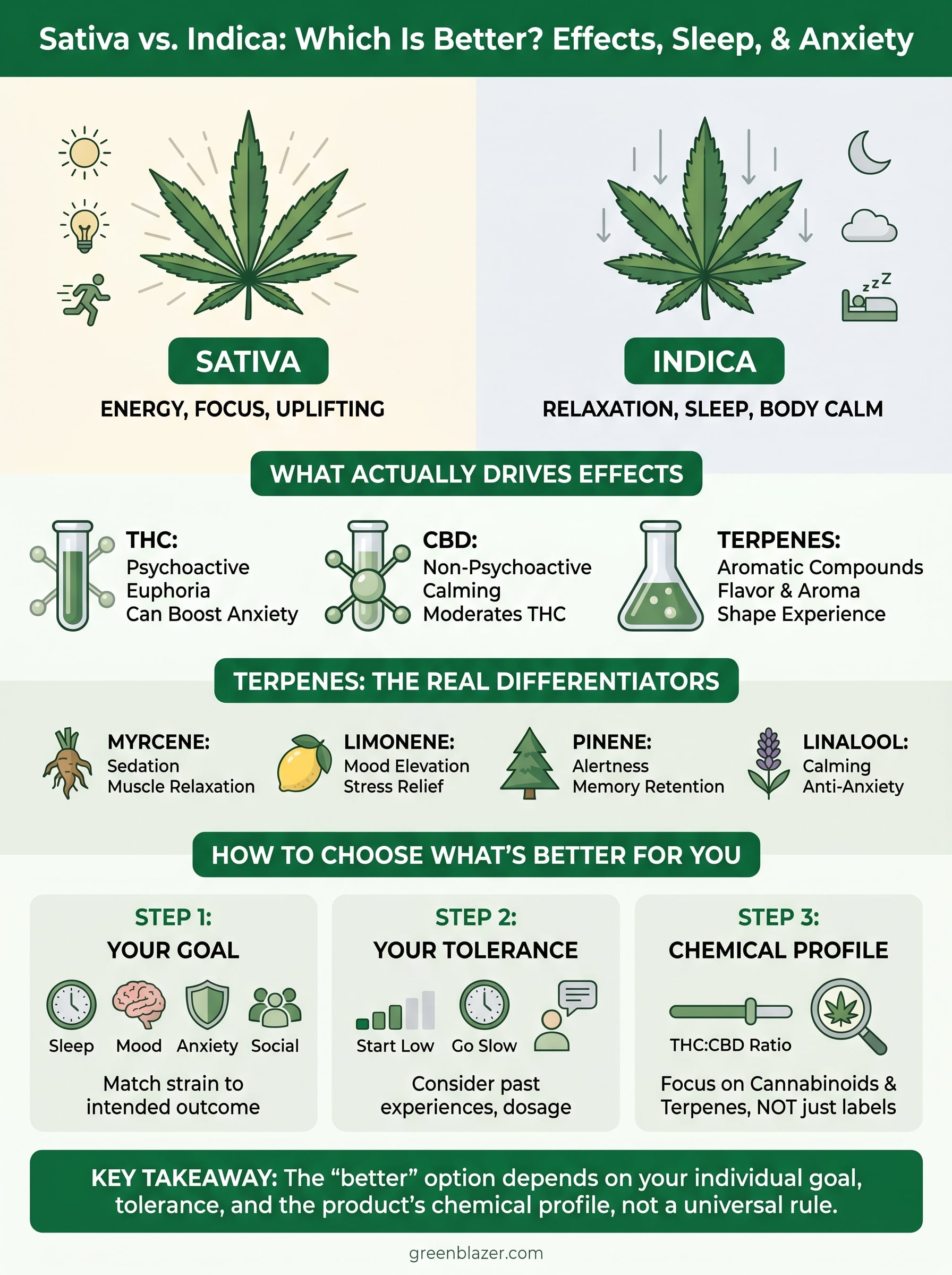
THC (tetrahydrocannabinol) is the main psychoactive compound in cannabis and the biggest factor in how intense your experience feels. Higher THC levels generally produce stronger euphoria, altered perception, and, in some users, increased anxiety. CBD (cannabidiol) works differently: it doesn't get you high on its own, but it does appear to moderate some of THC's more intense effects, including paranoia and racing thoughts. A strain with both THC and CBD in significant amounts often delivers a smoother, more balanced effect than a high-THC-only product.
The ratio of THC to CBD in a strain often tells you more about the likely experience than any sativa or indica label ever will.
Terpenes: the real differentiators
Terpenes are aromatic compounds found throughout nature, and cannabis carries dozens of them. They influence flavor, smell, and, critically, how cannabinoids interact with your brain and body. This interaction is sometimes called the entourage effect. Common terpenes include:
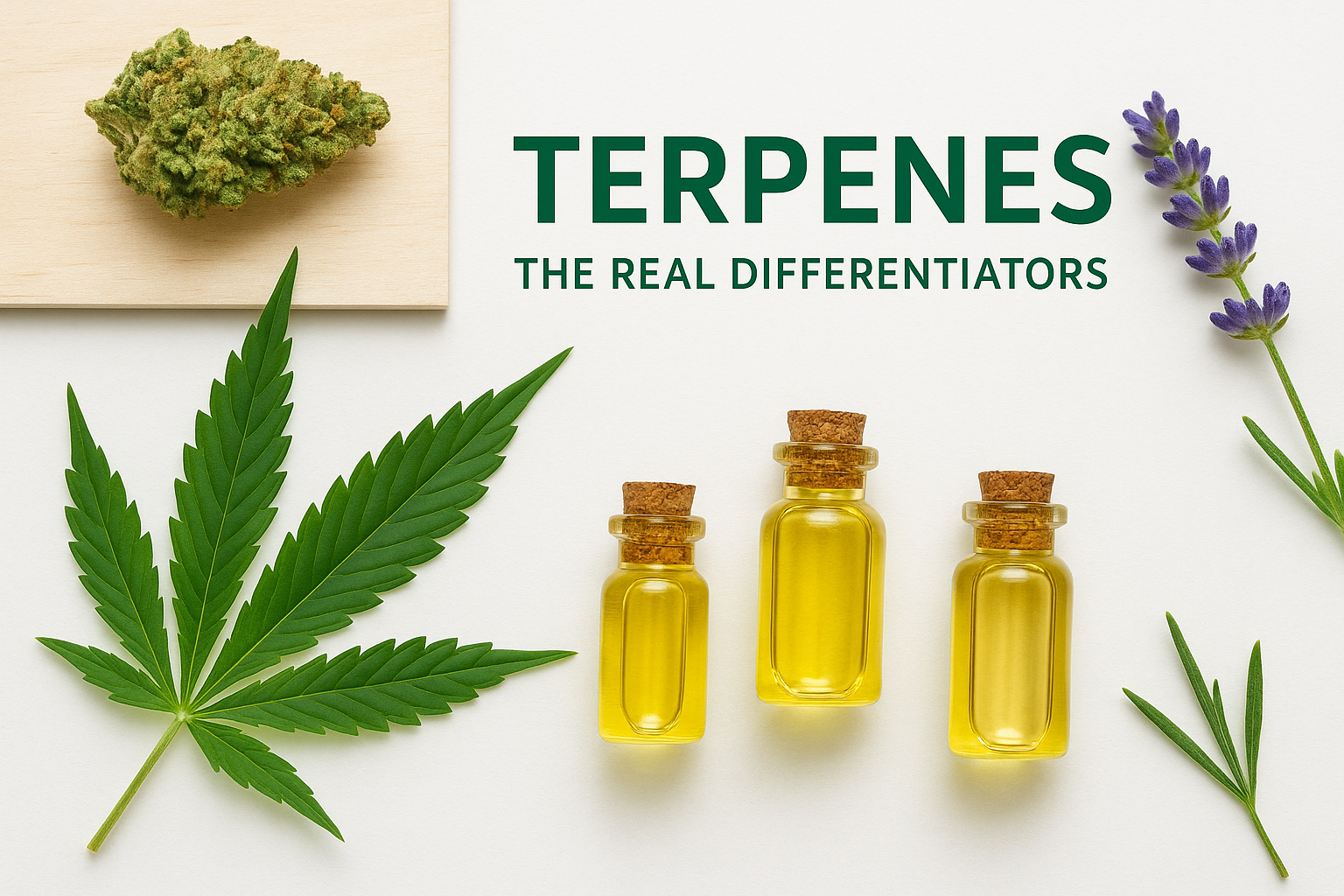
- Myrcene: earthy, associated with sedation and muscle relaxation
- Limonene: citrusy, linked to mood elevation and stress relief
- Pinene: piney, may support alertness and memory retention
- Linalool: floral, connected to calming and anti-anxiety effects
Paying attention to a strain's terpene profile rather than just its sativa or indica classification gives you a sharper tool for predicting and repeating the experiences you enjoy most.
Indica vs sativa effects for sleep, anxiety, and more
When people wrestle with sativa vs indica which is better, the conversation usually comes back to two specific goals: getting better sleep and managing anxiety. These are the most common reasons people reach for cannabis therapeutically, and the sativa-indica distinction plays a real, if imperfect, role in helping you hit those targets consistently.
Indica for sleep and body relaxation
Indica-leaning strains are widely associated with physical relaxation and a heavier body sensation, which is why they've earned the nickname "in-da-couch." This reputation traces back to their typical terpene profiles, particularly high myrcene content, which researchers have linked to sedative-like effects. For people who struggle to quiet a busy body at night, indica-leaning options tend to be the more reliable starting point.
Terpene-rich indica-leaning strains often deliver the physical wind-down effect that makes sleep feel more reachable, especially for people dealing with chronic tension or discomfort.
That said, individual tolerance and dosage matter enormously. A high-THC indica taken in a large dose can spike anxiety rather than calm it, which is the opposite of what most sleep-seekers want. Starting low and paying attention to how your body responds session to session gets you to a useful baseline much faster than chasing labels alone.
Sativa for anxiety: a mixed picture
Sativa-leaning strains are frequently marketed as uplifting and mood-boosting, which sounds appealing for anxiety. In practice, the picture is more complicated. Strains with very high THC and low CBD can actually worsen anxiety and overstimulate your nervous system, regardless of whether they're labeled sativa or indica. If anxiety is your primary concern, the THC-to-CBD ratio and the presence of calming terpenes like linalool matter far more than the strain category on the package.
How to choose which is better for you
Deciding sativa vs indica which is better for your specific needs comes down to three practical factors: your goal for the session, your personal tolerance, and the actual chemical profile of the product you're buying. Starting with these three anchors keeps you from getting distracted by marketing language or generic advice that doesn't apply to your situation.
Start with your goal, not the label
Your intended outcome is the most important filter you have. Before you pick up anything, ask yourself what you actually need from this session. The answers tend to cluster around a few clear categories:
- Sleep and physical recovery: Look for indica-leaning strains with high myrcene content and a moderate THC level
- Mood support or creativity: Sativa-leaning strains with limonene or pinene often deliver without overstimulating
- Anxiety relief: Prioritize a balanced THC-to-CBD ratio over any strain classification
- Social situations: Lower-THC options in either category reduce the risk of unwanted intensity
Matching the strain to the goal before you buy is far more reliable than choosing based on label alone.
Factor in your tolerance and history
Your past experiences with cannabis tell you more about what to choose than any general guide can. If you've had sessions where anxiety spiked or the high felt too intense, high-THC products in any category are worth approaching carefully. New users typically do better starting with lower THC percentages and working up gradually rather than jumping straight to potent strains based on a category label.
Your method of consumption also shapes the decision. Smoking a RAW cone gives you a relatively fast onset, which means you can gauge your response quickly and stop before you overconsume. That kind of real-time feedback makes it easier to calibrate your experience and zero in on what actually works for you.
How to use cannabis more safely and predictably
No matter where you land on sativa vs indica which is better, how you consume cannabis shapes your experience just as much as what you consume. Building a few simple habits around your sessions dramatically reduces the chance of an unpleasant outcome and helps you build a reliable picture of what works for your body.
Start low, go slow
New and returning users both benefit from the same foundational rule: start with less than you think you need. Smoking a RAW cone gives you a faster feedback loop than edibles, since you feel the onset within minutes and can stop before you've gone too far. Give yourself 10 to 15 minutes between puffs to let the effect settle before deciding whether you want more.
Starting at a lower dose and building gradually is the single most effective habit you can build for consistent, enjoyable sessions.
This approach is especially important if you're trying a new strain or a higher-THC product than you've used before. Even experienced users can misjudge potency when switching cultivars, so treating every new product like a first session protects you from overconsumption.
Pay attention to your setting and timing
Your physical environment has a measurable effect on how a session feels. Familiar, comfortable spaces tend to reduce anxiety and support relaxation, while high-stimulation environments can amplify the intensity of any strain. If you're using cannabis for sleep or stress relief, dimming the lights and removing distractions before you start sets the stage for the outcome you actually want.
Timing matters too. Using cannabis earlier in the evening rather than right before bed gives sedating effects time to peak and then ease naturally into sleep. Keeping a short mental log of what you used, how much, and how you felt afterward helps you connect the dots faster and repeat your best sessions more consistently.
Key takeaways to help you decide
The sativa vs indica which is better debate doesn't have a universal answer, and that's actually useful information. Your goal, your tolerance, and the specific chemical profile of the product you choose matter far more than any category label. Indica-leaning strains with high myrcene content tend to support sleep and physical relaxation. Sativa-leaning options with mood-lifting terpenes like limonene work better for focus and creativity. For anxiety, a balanced THC-to-CBD ratio beats any strain classification every time.
Building the habit of starting low, paying attention to terpenes, and tracking your sessions puts you in control of your experience rather than leaving it to chance. The right strain paired with a quality pre-rolled cone gives you a clean, consistent smoke that lets the flower do exactly what it's supposed to do. Find your preferred setup at Green Blazer.
