

If you found this page through Green Blazer, a company built around RAW pre-rolled cones and smoking accessories, you might have expected a different kind of joint. Fair enough. But the word carries real weight in anatomy, too. What is a joint in the human body? Put simply, it's the point where two or more bones connect, giving your skeleton the ability to move, absorb impact, and hold its shape.
Your body has roughly 360 joints, and they're not all the same. Some swing freely like the hinge in your elbow. Others are locked tight, like the fused plates in your skull. Each type serves a specific mechanical purpose, supporting weight, enabling rotation, or protecting delicate structures underneath.
This article covers the full picture: how joints are classified, what they're made of, and why they matter to your daily movement. Whether you're curious about the ball-and-socket design in your shoulder or the barely-there connections between vertebrae, you'll find a clear, straightforward breakdown below. No medical degree required.
Why joints matter for movement and stability
Understanding what is a joint goes beyond memorizing anatomy terms. Joints are the reason your body can do anything that involves movement. Every time you bend your knee to climb a stair, rotate your wrist to open a door, or tilt your head to check your phone, a joint is doing the mechanical work. Without them, your skeleton would be a rigid frame, incapable of adapting to the physical demands of daily life. Roughly 360 joints operate throughout your body, each contributing to a function that would otherwise be impossible.
Joints as the foundation of movement
Your joints allow two bones to work together rather than in isolation. When you reach for something on a high shelf, your shoulder joint rotates in its socket, your elbow extends, and your wrist tilts to adjust your grip. That entire sequence involves multiple joints firing in coordination, which your nervous system manages automatically. You don't think about it, but the mechanical precision required is significant.
Different joints are built for different ranges of motion. Your hip joint, a ball-and-socket design, can swing forward, backward, sideways, and rotate in a full circle. Your finger joints, simple hinges, only bend in one direction. The type of joint directly determines what movement you can perform with that part of your body, and no amount of stretching changes that structural limit.
The range of motion at any joint is not random - it reflects the exact mechanical requirements of that body part.
How joints provide structural stability
Movement is only half the story. Joints also keep bones from drifting out of alignment under physical stress. When you stand still, your knee joints lock into a stable position that keeps your body upright without requiring your muscles to work constantly. The structural design of the joint itself carries part of that load, which is why joint damage, even minor, can make standing or walking noticeably harder.
Stability and mobility pull in opposite directions within joint design. A joint built for wide movement, like your shoulder, sacrifices some stability to achieve that range. A joint built for maximum stability, like your sacroiliac joint in the pelvis, moves very little but handles enormous compressive forces from the weight of your upper body. Your body distributes these trade-offs across your skeleton based on what each region needs most.
The role of joints in shock absorption
Every step you take sends a force equal to several times your body weight through your lower body. Your joints, particularly the knee, hip, and ankle, absorb and redirect that force before it reaches your spine and skull. The cartilage inside these joints acts as a natural shock absorber, compressing slightly under load and rebounding when the pressure lifts.
Fluid also plays a key role here. The synovial fluid found inside most of your movable joints lubricates the surfaces and distributes pressure evenly so no single point takes the full impact of each step or jump. This system works continuously and silently, protecting your bones from the kind of repeated stress that would otherwise cause damage over time. When this system breaks down, as it does in conditions like osteoarthritis, you feel it quickly in the form of pain, stiffness, and reduced range of motion.
How joints are built
When you ask what is a joint at a structural level, the answer involves several distinct layers working together. A joint isn't simply two bones touching. It's a carefully engineered assembly of bone surfaces, cartilage, fluid, membranes, ligaments, and connective tissue, each layer contributing something specific to how the joint performs under load and sustained movement throughout your life.
The core components of a joint
The bones themselves form the foundation of every joint, but raw bone-on-bone contact would grind down quickly under normal use. To prevent that, most movable joints have their bone ends covered with articular cartilage, a smooth, dense tissue that reduces friction and cushions impact with each movement. This cartilage has no direct blood supply of its own, which is exactly why it repairs so slowly after injury compared to other tissues in your body.
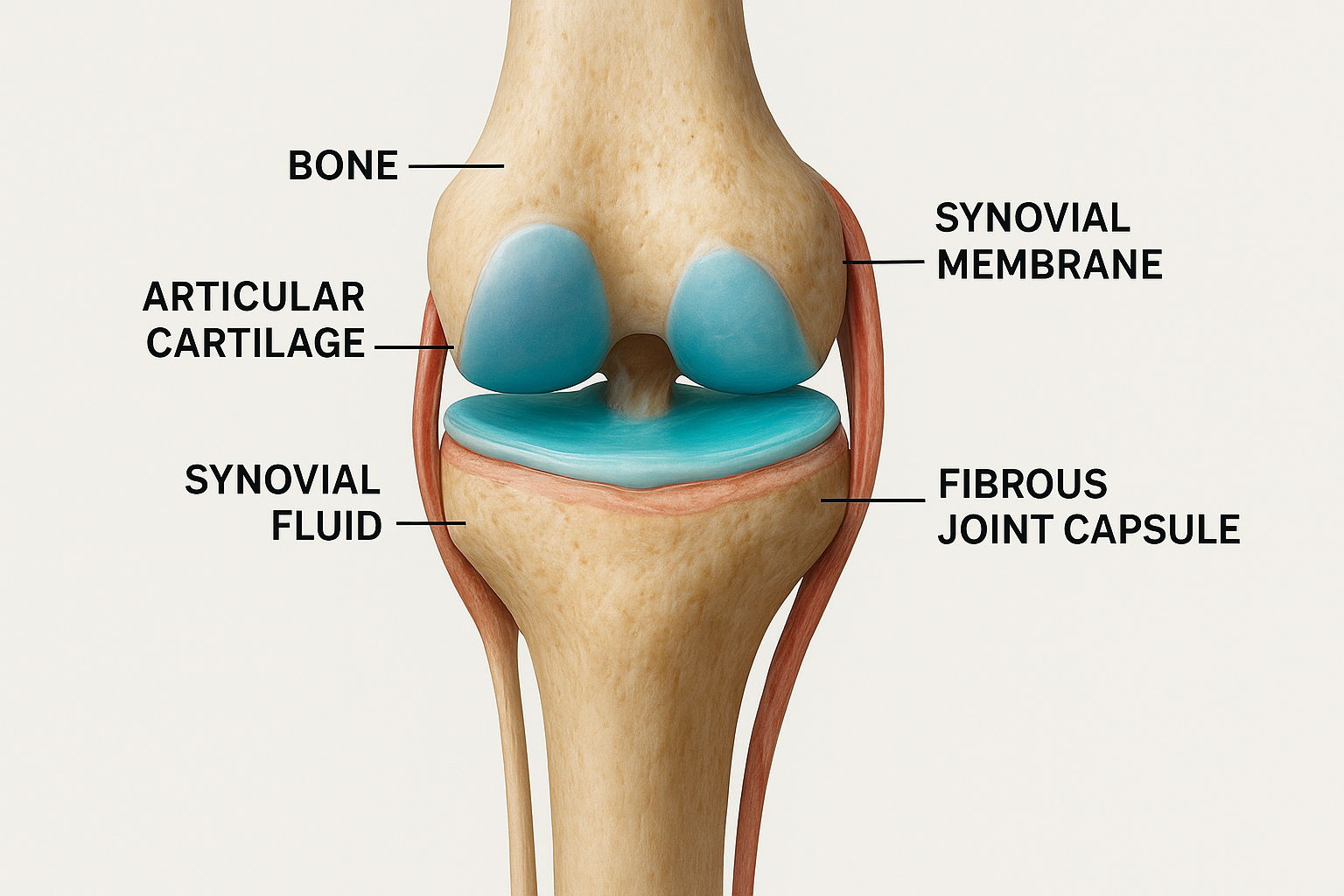
Surrounding the joint is the synovial membrane, a thin inner lining that produces synovial fluid. This fluid performs two functions: it lubricates the joint surfaces so they glide rather than grind, and it delivers nutrients directly to the cartilage that cannot receive them through blood vessels. The entire assembly sits inside a fibrous joint capsule that keeps the fluid contained and wraps the joint in an additional layer of structural protection.
The cartilage and synovial fluid together form a lubrication system so efficient that healthy joints produce less friction than wet ice sliding against wet ice.
What holds joints together
Cartilage and fluid keep the joint moving smoothly, but ligaments are what keep the bones in place. These tough bands of connective tissue run directly from one bone to another, acting as structural restraints that stop bones from shifting too far out of alignment during movement. Each joint has ligaments arranged to control its specific range of motion, which is why a ligament tear affects not just stability but the entire mechanical behavior of that joint.
Layered around all of this are muscles and tendons, which add dynamic stability on top of the passive support that ligaments provide. Tendons anchor muscles directly to bone, and when those muscles contract, they pull the joint into position and hold it there under load. This combination of passive restraint and active muscle support is what allows your joints to handle both sharp, sudden impacts and prolonged mechanical stress without breaking down under everyday conditions.
How joints move
Movement at a joint isn't random. Every joint in your body moves according to a specific mechanical pattern determined by its shape, the surrounding tissues, and the muscles that act on it. Understanding what is a joint from a motion perspective means looking at both how the movement happens and what controls it, because these two things work together every time you take a step, reach for something, or turn your head.
The mechanics of joint motion
Most movement at a joint falls into one of several basic categories. Flexion and extension describe the bending and straightening you perform when you curl your arm at the elbow or kick your leg forward. Abduction and adduction describe movement away from or toward the centerline of your body, like when you raise your arm out to the side or bring it back down. Rotation describes twisting around a central axis, which you use constantly when turning your head or pivoting your hip.
Your body combines these movements fluidly rather than performing them one at a time. When you throw something, your shoulder goes through multiple planes of motion simultaneously, rotating while also extending and slightly abducting. The synovial joint design in your shoulder makes this combination possible by allowing the rounded head of your upper arm bone to glide and spin within its shallow socket without locking into a single track.
Joint movement is always a combination of bone shape, tissue tension, and muscular control working at the same time.
What limits joint movement
Your joints don't move without boundaries, and those limits exist for a reason. Ligaments act as physical stops, reaching full tension before a bone can move too far in any direction. You feel this as a firm endpoint when you try to hyperextend your knee or push a joint past its natural range. This isn't a flaw in the system. It's a built-in protective mechanism that guards against dislocation and ligament tears during ordinary activity.
Muscle tightness and capsule flexibility also shape your available range of motion. If the muscles around a joint are chronically shortened from sitting too long or underuse, they pull the joint into a compressed position and reduce how freely it can move. Regular movement and targeted stretching keep the joint capsule supple and the surrounding musculature long enough to allow full, unrestricted motion through the range that joint was designed to perform.
Types of joints in the body
When you explore what is a joint and how it works, classification gives you the clearest picture of why your body moves freely in some places and barely moves at all in others. Anatomy organizes your roughly 360 joints using two separate systems: one based on physical structure and one based on how much movement a joint allows. Both systems overlap in useful ways, and understanding them together helps you make sense of every motion your body performs.
Joints classified by structure
Your skeleton contains three structural categories of joints. Fibrous joints hold bones together with dense collagen fibers and allow little to no movement. The sutures in your skull are the most recognizable example, locking the skull plates together permanently after early childhood. Cartilaginous joints connect bones through a layer of cartilage, like the discs between your vertebrae, which allow limited compression and slight movement under load. The third type, synovial joints, are the most complex and most movable, featuring a fluid-filled cavity that separates the bone surfaces and allows coordinated, multi-directional movement.
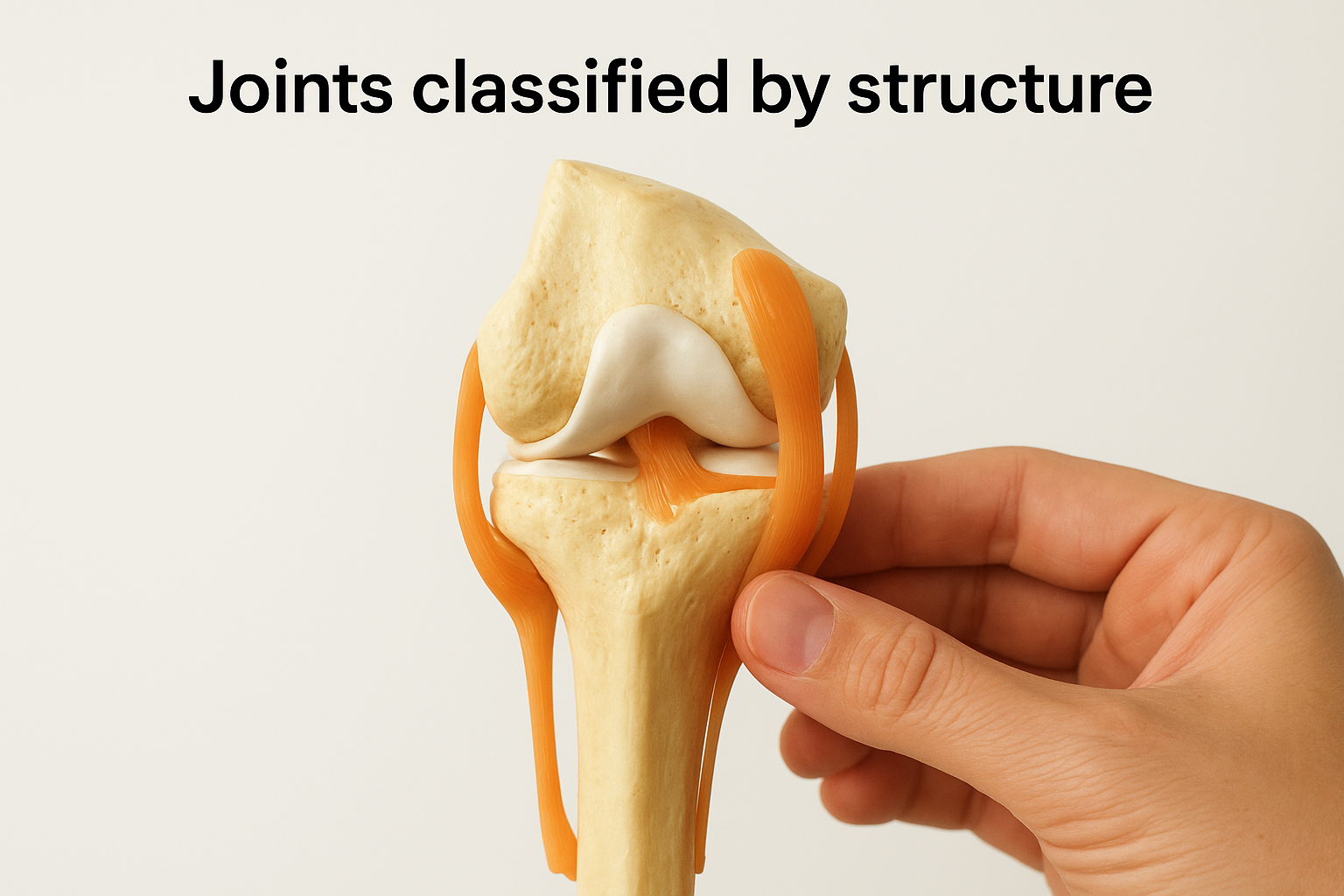
Synovial joints account for the vast majority of the movement you use during daily activity, from walking and gripping to rotating your neck.
Synovial joints break down further into six subtypes based on their shape and the specific movement pattern they support. The table below covers each type along with a practical example from your own body:
| Synovial joint type | Example location | Movement allowed |
|---|---|---|
| Hinge | Elbow, knee | Flexion and extension only |
| Ball-and-socket | Hip, shoulder | Full rotation and multi-directional movement |
| Pivot | Neck (atlas-axis) | Rotation around a single axis |
| Gliding (plane) | Wrist carpal bones | Small sliding movements |
| Saddle | Base of the thumb | Two-plane movement without rotation |
| Condyloid | Wrist (radius to carpals) | Flexion, extension, and side-to-side movement |
Joints classified by function
Beyond structure, anatomy also groups joints by how much movement they permit. Synarthroses are completely immovable joints, matching up almost entirely with fibrous joints in the skull and pelvis. Amphiarthroses allow limited, controlled movement and include cartilaginous joints like the ones between your ribs and sternum. Diarthroses are fully movable joints and correspond almost directly to the synovial category above.
Both classification systems frequently overlap. A fibrous joint almost always functions as a synarthrosis, while a synovial joint almost always acts as a diarthrosis. Recognizing both layers gives you a reliable framework for understanding your body's mechanical design from the ground up.
Common joint conditions and warning signs
Knowing what is a joint and how it works gives you a clearer picture of what can go wrong. Joints operate under constant mechanical stress, and over time, that load takes a toll on the cartilage, fluid, and surrounding tissue that keep the joint running smoothly. Recognizing the most common joint conditions and the warning signs they produce puts you in a better position to act before minor dysfunction becomes long-term damage.
Conditions that affect joint function
Osteoarthritis is the most widespread joint condition worldwide, occurring when articular cartilage wears down gradually and leaves bone surfaces with less cushioning between them. It typically develops in weight-bearing joints like the knees, hips, and spine, and becomes more common with age, prior injury, and sustained mechanical overload. The joint doesn't degenerate overnight. It deteriorates slowly, which is why early symptoms are easy to dismiss.
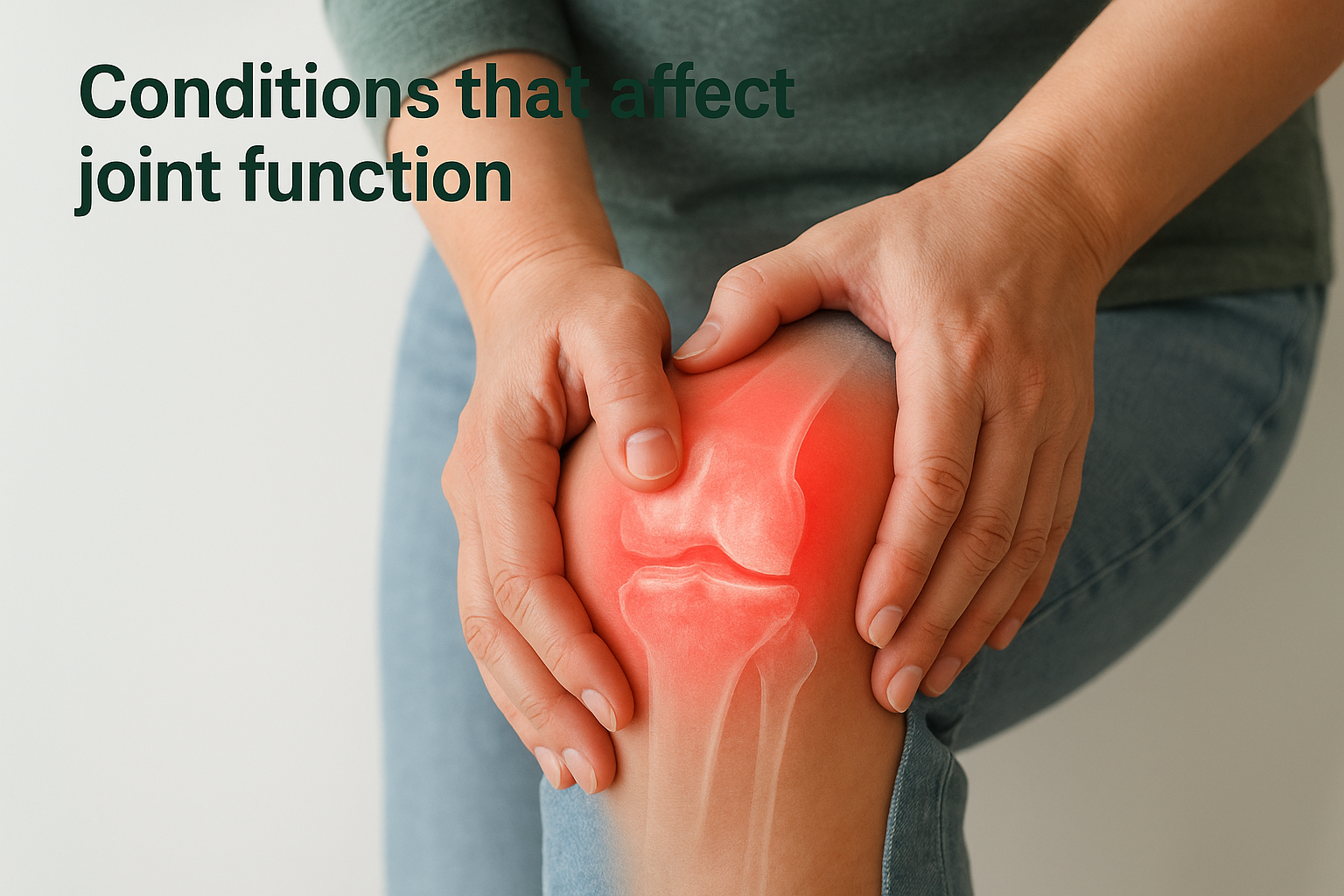
Rheumatoid arthritis follows a different path. Rather than mechanical wear, it results from your immune system attacking the synovial membrane directly, causing inflammation that degrades cartilage and bone over time. It often appears symmetrically, affecting the same joints on both sides of your body, and tends to strike smaller joints first, such as those in your fingers and wrists. Gout, another inflammatory condition, occurs when uric acid crystals accumulate inside a joint, most often the big toe, producing sudden and intense pain.
Inflammatory joint conditions affect the synovial membrane first, while degenerative conditions like osteoarthritis target the cartilage directly.
Warning signs you shouldn't ignore
Persistent joint pain that lasts longer than a few days without a clear cause is the most obvious signal that something needs attention. Pain after activity is common and often benign, but pain at rest or pain that wakes you up at night points to something more significant going on inside the joint itself.
Swelling, warmth, and redness around a joint indicate active inflammation, which can accelerate tissue damage if left unaddressed. Stiffness that lingers for more than 30 minutes after waking up is a classic early marker of inflammatory arthritis specifically. A grinding or clicking sensation during movement, particularly in the knee, can suggest cartilage loss or structural irregularities inside the joint.
Any combination of these symptoms, especially when they appear together or progressively worsen, warrants a conversation with a healthcare provider. Early intervention consistently produces better outcomes than waiting until the joint's structural integrity is significantly compromised.
How to take care of your joints
Understanding what is a joint and what damages it points directly toward what protects it. Your joints respond to how you load them, how often you move them, and what you put into your body. Most of the factors that drive joint deterioration are ones you can actually influence through consistent daily choices rather than expensive interventions.
Movement and exercise
Regular movement is the most direct way to maintain healthy cartilage and synovial fluid function. Low-impact activities like swimming, cycling, and walking keep the fluid circulating and deliver nutrients to cartilage that has no blood supply of its own. Strength training matters equally. Muscles surrounding a joint absorb mechanical load actively, reducing the raw stress that the joint surfaces have to handle during movement. Weak muscles transfer more of that force directly to cartilage and ligaments, accelerating wear over time.
Consistent movement does more for long-term joint health than any supplement or passive treatment.
Sitting for long stretches compresses joints unevenly and restricts nutrient delivery through the cartilage, leaving the tissue stiffer and more vulnerable to damage. If your work involves extended periods of sitting, getting up and moving through basic ranges of motion every 30 to 60 minutes makes a measurable difference in how your joints perform throughout the day.
Diet and weight management
Body weight directly affects the load your joints carry with every step you take. Research consistently shows that each pound of body weight adds roughly four pounds of force across your knee joint during walking. Reducing excess weight lowers that load substantially and slows the rate at which cartilage wears down in weight-bearing joints like your knees and hips.
Food choices also shape joint health from the inside. Fatty fish, leafy greens, nuts, and olive oil provide nutrients that reduce systemic inflammation, which is a primary driver of cartilage and synovial membrane damage in both degenerative and inflammatory conditions. Staying well-hydrated supports your joints too, since synovial fluid depends partly on adequate water intake to maintain its lubricating and nutrient-delivery functions. Processed foods high in refined sugars and saturated fats do the opposite, promoting the kind of low-grade inflammation that compounds mechanical stress on your joints over time.
Quick recap
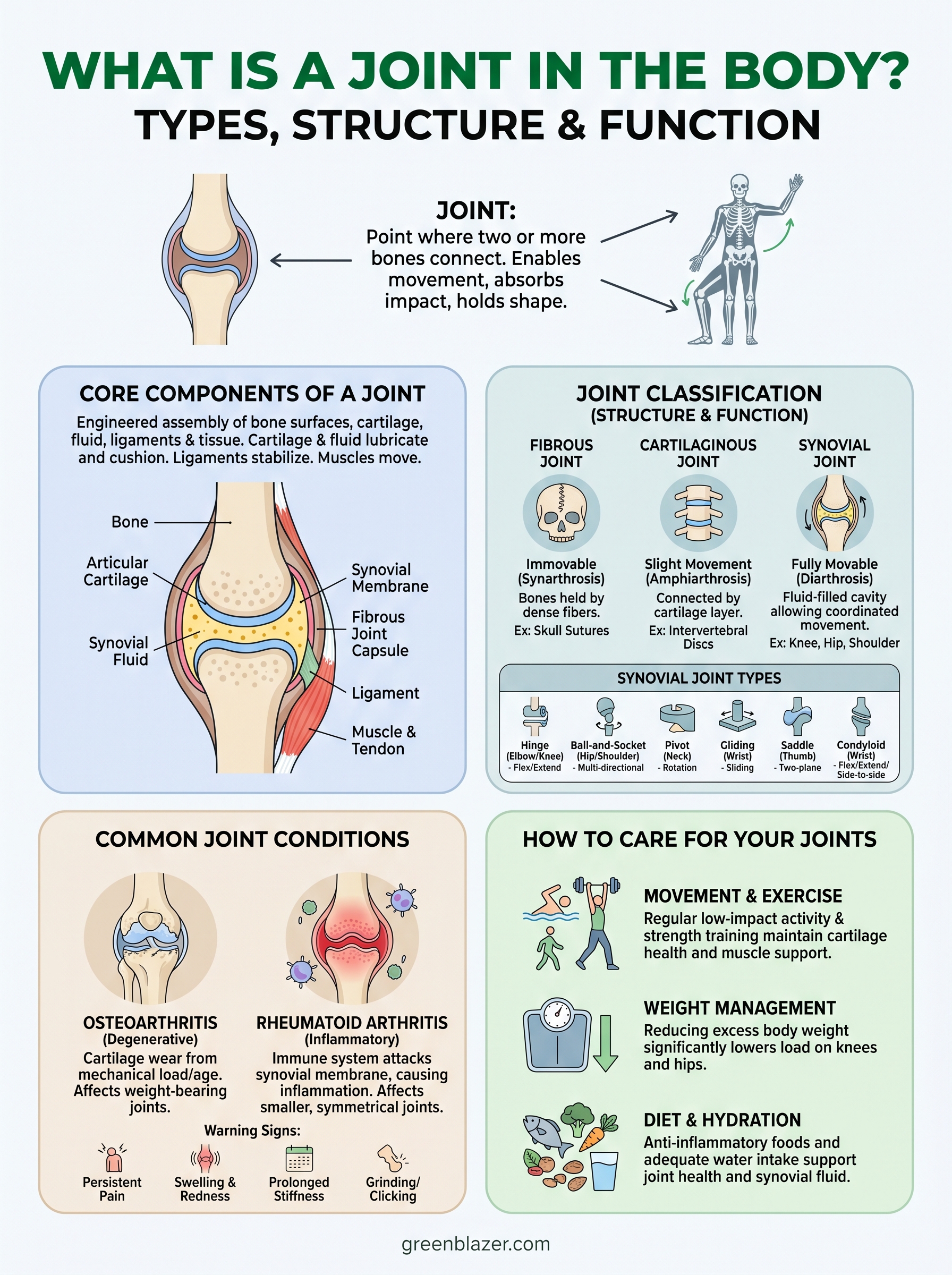
A joint is the point where two or more bones meet, and that simple definition covers a system far more complex than most people realize. Your body contains roughly 360 joints, each built from layers of cartilage, synovial fluid, ligaments, and muscle that work together to enable movement and absorb mechanical stress throughout your life. Some joints move freely in multiple directions, others barely shift at all, and a few are fused completely to protect critical structures underneath.
What is a joint in practice? It's the mechanical foundation of everything you do physically, from walking and lifting to simply holding your posture upright. Consistent movement, managed body weight, and anti-inflammatory eating are your most reliable tools for keeping joints healthy over the long term. Your joints respond directly to how you treat them every day, and small consistent habits make a bigger difference than any single intervention.
If you came here looking for a different kind of joint, browse RAW pre-rolled cones and smoking accessories at Green Blazer.
