

Cannabis concentrates for beginners come down to one rule. Concentrates are extracts of the plant's resin, so they are much stronger than flower, and you should start with a tiny amount of a lower-potency product. Flower rarely tests above 30% THC, while concentrates usually land between 40% and 90%, and some reach 99%. A pinch of kief, a small amount of hash, or a puff from a low-dose cartridge is a sensible first step.
This guide covers why the potency gap matters, how the main types compare side by side, how to dose and which gentle options to try first, the ways to consume concentrates, and what to check before you buy. You will see worked numbers, a comparison table, and a simple routine you can follow on your first few sessions.
Green Blazer is a RAW cone distributor, so our focus is the smoking side of cannabis. We keep this guide practical and neutral. It is written for adults of legal age, in places where cannabis is legal, so check your local laws before you buy or use anything described here.
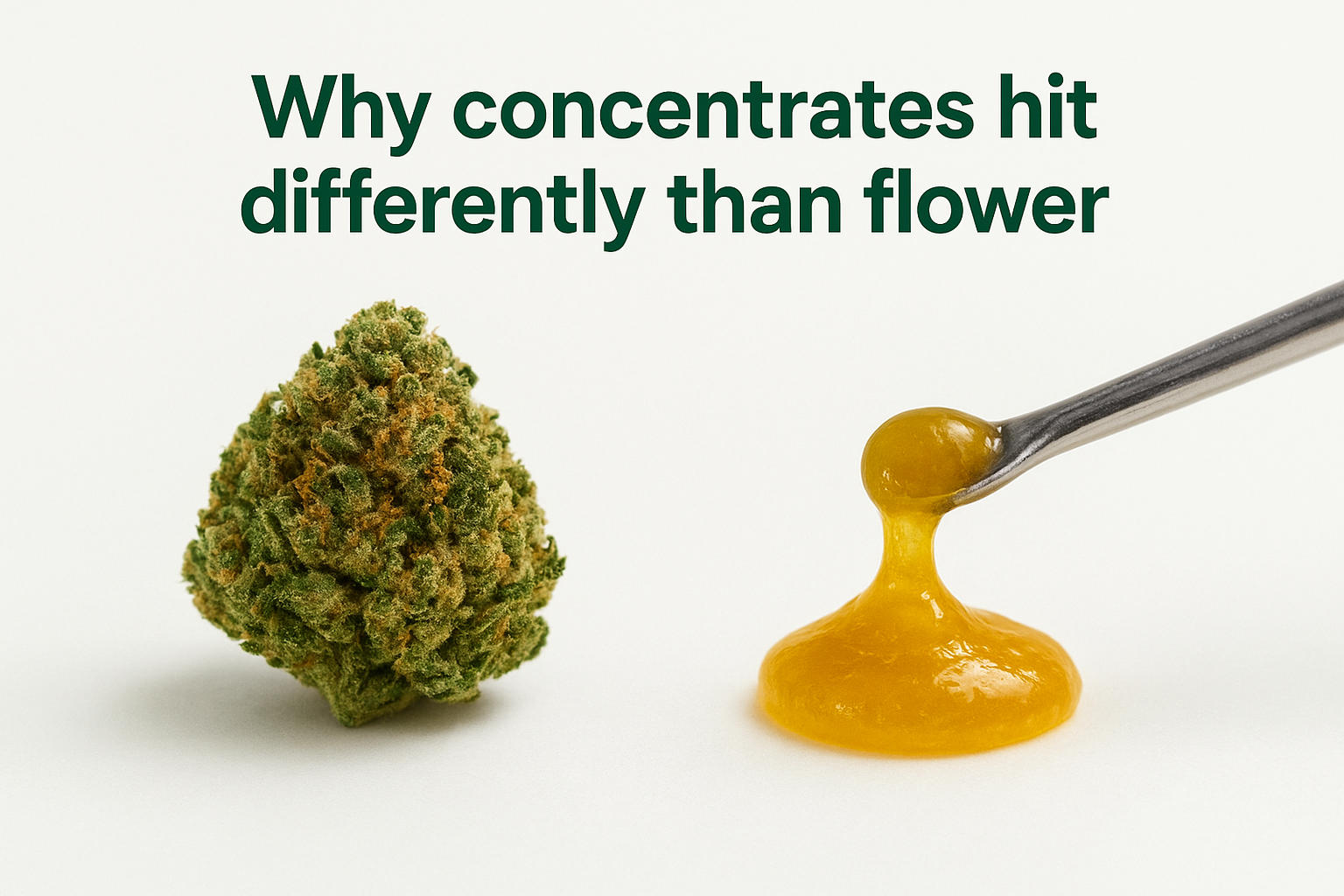
Why concentrates hit differently than flower
Concentrates matter to beginners because potency per gram is several times higher than flower, and your body responds to that jump quickly. A product that feels mild on a label can feel overwhelming if you treat it like a pinch of regular flower. Knowing the gap before you buy is the single best way to avoid a bad first experience.
What a concentrate actually is
A concentrate is made by pulling the resin glands, called trichomes, off the plant and collecting them in a purer form. Trichomes hold most of the cannabinoids and terpenes. Cannabinoids such as THC and CBD drive the effects. Terpenes are the aromatic compounds that give each product its smell and flavor.
Concentrates can be made with solvents or without them, and the method shapes texture, flavor, and price. Most contain THC as the main cannabinoid, though some are CBD-heavy, and minor cannabinoids like CBG and CBN show up too. A good one keeps the plant's full range of compounds, terpenes included, instead of a single isolated molecule.
The potency gap in numbers
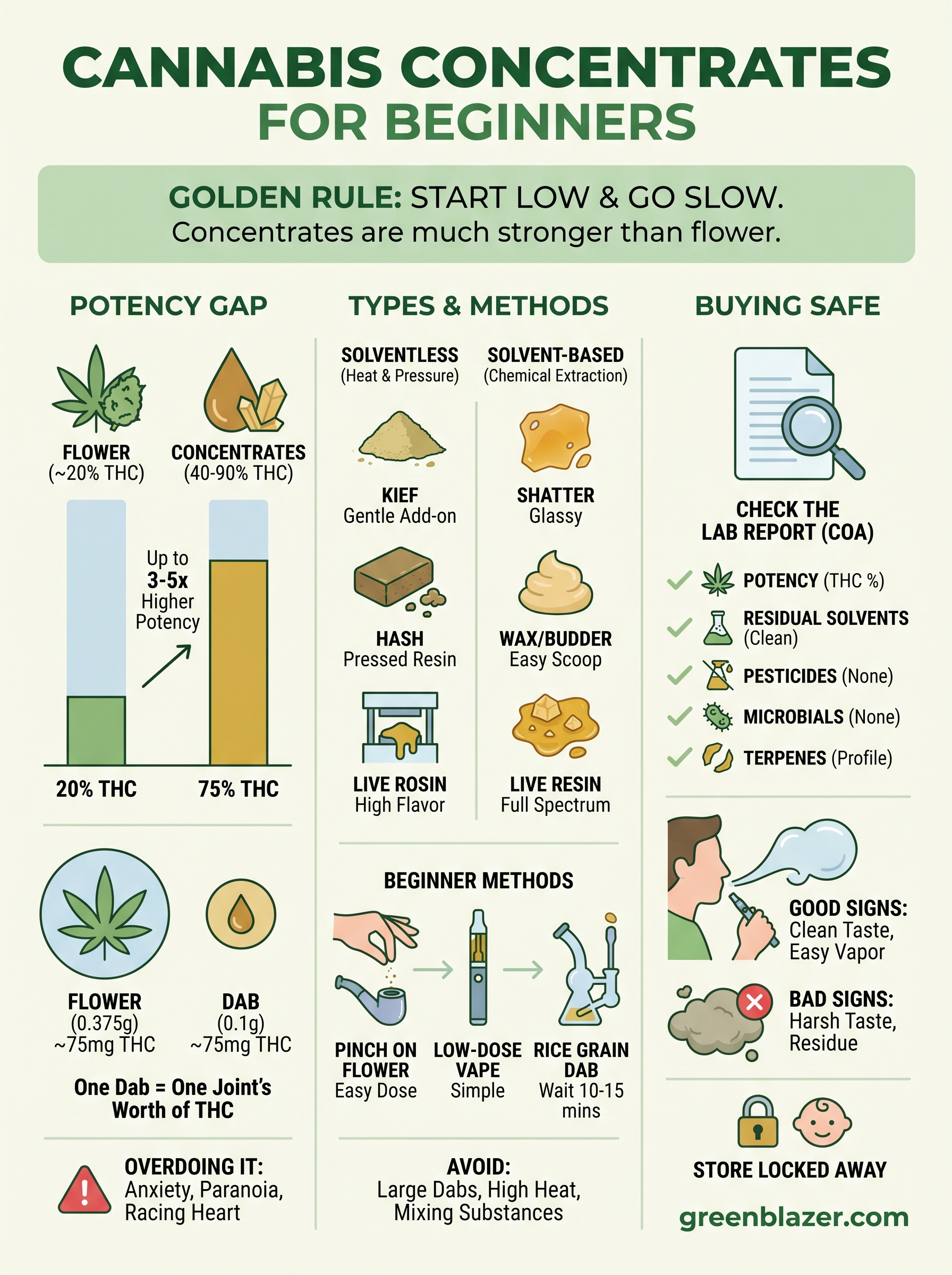
Top-shelf flower typically measures around 20% THC, and concentrates can be up to four times stronger. Here is what that looks like for one inhale, using the THC content of the material (what your body absorbs is lower, because some vapor is lost):
- A 0.1 gram dab at 75% THC holds 75 mg of THC.
- You would need about 0.375 grams of 20% flower to hold the same 75 mg.
- A beginner-sized dab of 0.02 grams at 70% THC holds about 14 mg.
That first line is the trap. One big dab packs the THC of a generous joint into a single breath, and it arrives fast. The third line is your target: a portion small enough that you stay in control.
A single heavy dab can deliver as much THC as a full joint's worth of flower, in one breath.
What too much feels like
Overdoing it usually brings anxiety, paranoia, a racing heart, and dizziness. Government health sources also list panic attacks and, at high doses, hallucinations. The long-term effects of regular concentrate use are not yet well understood.
A bad session is not dangerous for most healthy adults, but it is unpleasant and avoidable. The fix is simple. Take less than you think you need, wait, and decide afterward whether to take more.
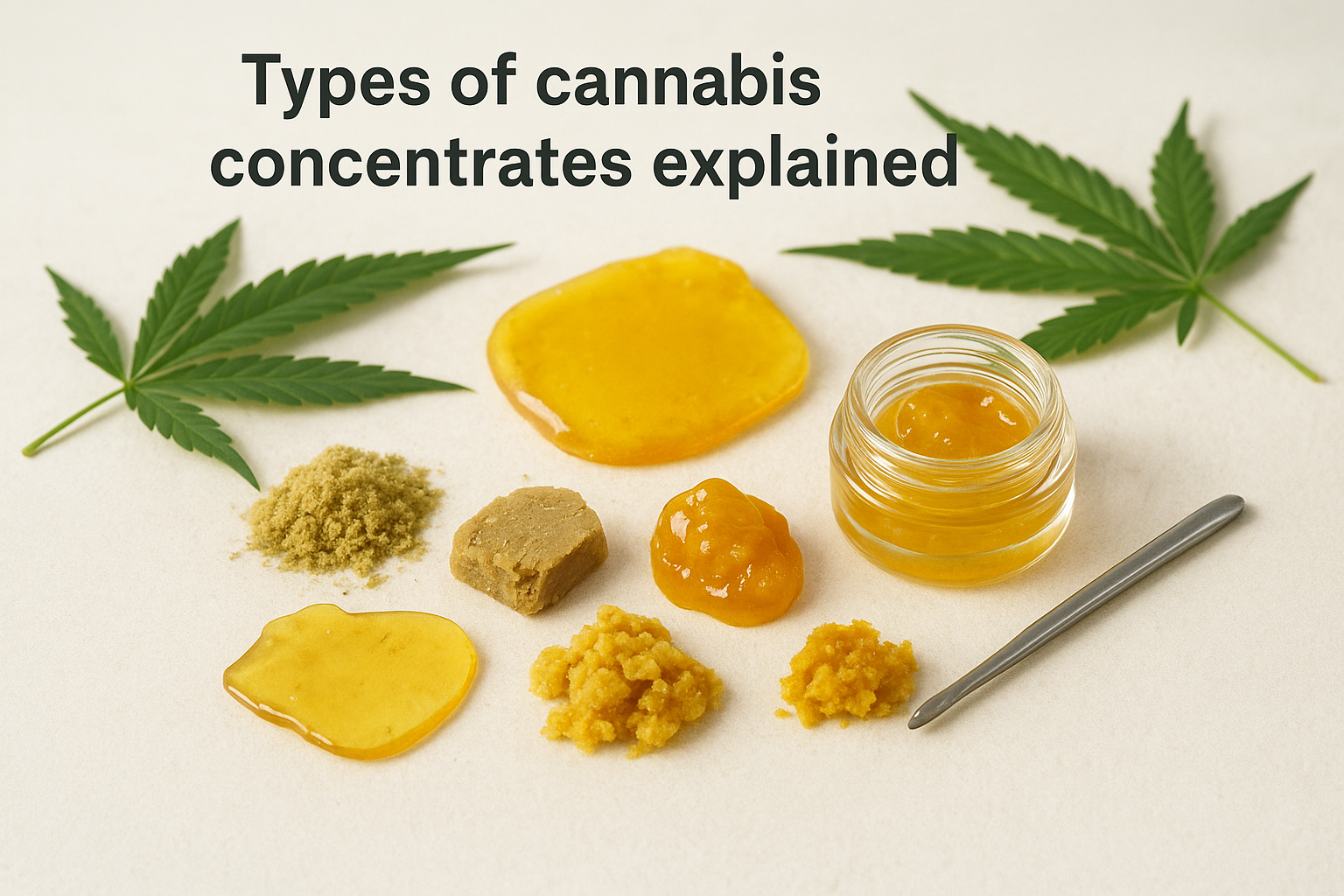
Types of cannabis concentrates explained
The main types of cannabis concentrates split into two families. Solventless products use heat, pressure, or mechanical separation. Solvent-based products use a chemical such as butane, propane, ethanol, or CO2 to dissolve the resin, then purge the solvent. Within each family, texture, potency, and flavor set the types apart.
How concentrates are made
Solvent-based extraction passes a solvent through flower or fresh-frozen plant, then removes the solvent under heat and vacuum. Wax, shatter, crumble, budder, sauce, live resin, and hash oil all come from this route. The differences in texture come mostly from how the oil is handled afterward. Shatter is left mostly undisturbed so it stays glassy. Wax and budder are whipped to add air.
Solventless extraction skips the chemicals. Kief is simply collected trichomes, and a grinder with a kief catcher gathers it as you grind. Hash is pressed or processed resin. Rosin is made by squeezing flower or hash under low heat and pressure.
A question beginners often ask is how much flower it takes to make 1 gram of concentrate. Yields vary a lot with the method and the plant material, but a rough range is about 4 to 10 grams of flower per gram. That is why concentrates are strong and often pricey. Do not try this at home with solvents, because butane and similar solvents are flammable and explosive in poorly ventilated spaces.
The main types compared
The table below sets the common types side by side, using typical lab-tested ranges. Individual products vary, so always read the label.
| Type | Texture | Typical THC | Beginner note |
|---|---|---|---|
| Kief | Loose powder | Varies by flower | Easiest to dose, sprinkle on flower |
| Hash | Pressed or crumbly resin | Varies, usually below refined extracts | Gentle add-on for flower |
| Live rosin | Soft, sticky, solventless | 60% to 85% | Excellent flavor, strong, for later |
| Live resin | Sticky, taffy-like | 65% to 95% | Strong, flavor-forward |
| Shatter | Hard, glassy | 70% to 90% | Brittle, harder to portion |
| Wax, budder, badder | Soft, whipped | 60% to 90% | Easy to scoop, still strong |
| Crumble | Dry, honeycomb | 60% to 90% | Easy to sprinkle |
| Terp sauce | Thick, syrupy | 40% to 60% | Lower THC share, very aromatic |
| Moonrocks | Flower coated in oil and kief | 45% to 65% | Dense, strong for a flower |
Notice that everything refined sits well above flower. For a first try, the options at the top and bottom of the potency range are the most forgiving.
If a product is labeled above 60% THC, treat it as an advanced product, not a starter.
Vape cartridges and edibles
Vape cartridges hold cannabis oil and attach to a battery pen, so they are the most popular concentrate format. Quality varies widely, and the best ones skip additives and fillers and use parts that do not leak or clog. Edibles and tinctures also use concentrates, but they work on a different timeline, which the consumption section covers.
How to start low: doses and gentle options
To start with concentrates, pick one lower-potency product, take a very small amount, and wait before taking more. Beginners get into trouble when they combine a new product, a new method, and a large portion in the same session. Change one thing at a time.
The gentlest products to try first
No concentrate is truly weak, but some are far easier to dose gently than others. Here is a practical order from mildest to stronger:
- Kief on flower. A small pinch on a bowl or mixed into ground flower raises potency modestly. It is easy to measure by eye.
- Hash mixed with flower. Hash is potent but generally less so than full-melt concentrates, and it works well as an add-on, and a look at hash vs weed shows how the two differ.
- Low-THC or balanced vape cartridges. Look for products with a lower labeled THC percentage or some CBD in the blend, and a clean ingredient list.
- Terp sauce. With a THC range of roughly 40% to 60%, it has more terpenes and less THC than most dabbing products.
- Live rosin or live resin. Wonderful flavor, but save them until you know how you respond.
Whichever you pick, buy the smallest package available. A half gram of a strong concentrate lasts a beginner a long time, and a gram you will not finish is not a bargain.
A dosing routine you can follow
Use this routine for your first few sessions:
- Choose a safe, comfortable place, ideally at home, with water and a snack nearby.
- Take a portion about the size of a grain of rice, or a single short puff from a cartridge.
- Wait at least 10 to 15 minutes for inhaled products. Effects can build, and you may find you need nothing more.
- If you want more, take half of your first portion.
- Do not drive, and avoid mixing with alcohol.
For edibles or tinctures made with concentrates, the wait is much longer. Effects can take up to two hours, and taking a second dose too early is the classic mistake.
Which cannabis is best for beginners
For the starting material, the best choice is usually lower THC with some CBD, not the highest number on the shelf. A balanced product tends to feel smoother, which gives you room to learn how you react. After a few comfortable sessions, you can move up gradually. If you have a heart condition, are pregnant, or take medication, talk with your doctor first.
Start with the smallest portion of the mildest product, and let time, not impatience, decide your next dose.
How to consume concentrates as a beginner
The easiest ways to use concentrates are a vape pen with a cartridge and sprinkling kief or crumble onto flower. Both need little equipment and little practice. Dab rigs offer the best flavor, but they come with a learning curve and real heat safety concerns.
Methods compared
| Method | Gear | Learning curve | Good for beginners? |
|---|---|---|---|
| Vape cartridge on a battery pen | Pen and cartridge | Very low | Yes, simplest |
| Topping flower (a pinch of kief, hash, or crumble) | Flower and a pipe or bowl | Low | Yes, easy to control |
| Concentrate in a joint | Ground flower, papers or cones | Low to medium | Yes, with a small amount |
| Electronic rig | Rig and heating element | Medium | Maybe, after a few sessions |
| Dab rig with torch | Glass rig, banger, torch, dab tool | High | Not at first |
| Edibles and tinctures | Pre-made product | Low | Yes, but slow onset |
Vape pens do not handle every concentrate. Hard shatter and sticky wax can clog a standard cartridge pen, so use cartridges sold for that pen and reserve solid extracts for devices built for them, such as a wax pen.
Dabbing basics
Dabbing means vaporizing a small amount of concentrate on a hot surface, usually a quartz banger, and inhaling the vapor. It delivers the cleanest flavor and the fastest effect. Vaporizing also avoids burning the extract, and burning destroys much of the temperature-sensitive terpene content.
If you try a traditional rig, remember the torch is a real fire and burn hazard. Let the banger cool for a few seconds before dabbing, so the vapor is smoother and the heat does not scorch the concentrate. An electronic rig removes the torch and lets you control the temperature. Lower temperatures usually taste better and feel gentler, which suits a beginner.
Adding concentrates to flower and cones
Mixing a concentrate with ground flower is a forgiving way to learn. Kief and crumble sprinkle easily. Soft wax and budder are better pressed into the flower, because a blob of sticky oil on its own does not burn evenly. Always grind the flower first, mix in a small amount, and keep the total light.
This is where cones fit in. If you smoke from pre-rolled cones, Green Blazer carries RAW cones in several sizes, including the small Dogwalker Mini. A smaller cone naturally limits how much you use in one go. Start with a light, even mix of ground flower and a small pinch of kief, not a heavy coating.
The best beginner method is the one with the fewest moving parts: a pen, or a pinch on flower.
How to buy safe, tested concentrates
The safest way to buy concentrates is from a licensed seller who shows a lab report for the exact batch. Concentrates are only as clean as the process behind them, and you cannot see contamination by looking. A tested product gives you real information about what you are inhaling.
What to check on a lab report
A certificate of analysis, or COA, is the lab's report on a batch. Look for these items:
- Potency: the THC and other cannabinoid percentages should match the label.
- Residual solvents: confirms leftover butane, propane, or ethanol is below safe limits.
- Pesticides and heavy metals: screens for contaminants from the plant itself.
- Microbials and mold: screens for biological contamination.
- Terpene profile: a healthy range suggests a full-spectrum product rather than a stripped one.
If a seller cannot or will not show you the COA, treat that as a reason to pass.
Quality signs you can judge yourself
Good concentrates taste good and vaporize easily. A harsh, chemical taste suggests additives or poor purging. Some products are "full-melt" and turn almost completely into vapor. "Half-melt" products hold more plant matter and burn rather than vaporize. If a product vapes easily and tastes clean, it is probably well made.
For cartridges, check the ingredient list. Some brands use thinners or synthetic fragrances that degrade quality. Cleaner, simpler lists are better. Also buy from brands that disclose their extraction method, so you know whether you are getting a solvent-based or solventless product.
Which type is the safest
There is no risk-free concentrate, because potency is the main safety issue. Still, a solventless product from a licensed shop, with a clean COA and a low THC label, is about as safe as a beginner choice gets. Solventless extracts avoid the solvent residue question entirely, though they still need testing for pesticides and mold.
Store everything locked up and away from children and pets, and never share a rig you cannot clean. Do not buy from unlicensed street sources. Lab testing is exactly what they skip.
Buy tested, buy small, and walk away from any product that will not show its lab report.
Start small and stay in control
Concentrates are the same plant as flower, only packed far tighter, so the beginner rule is to respect that strength. Choose a gentle product like kief, hash, or a low-dose cartridge. Take a portion about the size of a grain of rice, wait, and move up slowly only if you want to. Buy tested products, avoid additives, and keep your setup simple until you know how you respond.
If you want a convenient way to enjoy flower alongside a light pinch of kief, a well-made cone helps keep your portions steady, and using RAW cones for the first time is easy to learn. You can browse RAW cones, papers, and accessories at Green Blazer, where every order comes with a 100% satisfaction guarantee.
